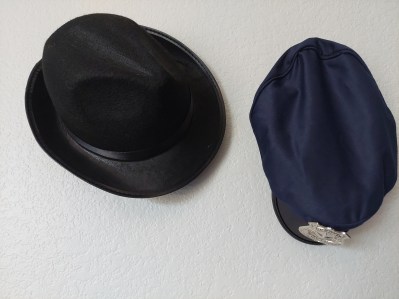
 In real life, police are privy to a lot of information that civilians can’t easily get. Even professional private detectives can’t get all of the information they might want because the law doesn’t require anyone to talk to them. Authors know this. That’s why many crime writers with amateur sleuths and PI sleuths include a police officer as a friend or at least an acquaintance. It doesn’t always meet the credibility challenge, but when it’s done well, an unofficial police partnership can be effective.
One of the most famous is, of course, Agatha Christie’s Hercule Poirot and Chief Inspector Japp. In some of the earlier stories, Japp’s not entirely happy about Poirot’s investigations. But as time goes by, the two come to respect each other. And, since Poirot is often able to put people at ease in ways that a cop couldn’t, Japp finds it useful to work with Poirot. And in One, Two, Buckle My Shoe (AKA The Patriotic Murders and An Overdose of Death), Japp finds himself taken off a case and depends on Poirot to keep looking into it. For his part, Poirot depends on the police for information. Their partnership works well for both of them.
There’s also an interesting partnership in Dorothy L. Sayers’ Lord Peter Wimsey novels. When many people think of Wimsey, they think of Mervyn Bunter as his partner/sidekick. But Inspector Charles Parker also plays an important role in the novels. He and Wimsey are friends to begin with, and Wimsey does take an interest in Parker’s cases. For his part, Parker appreciates Wimsey’s perspective, and finds his input very helpful. Their friendship only grows and deepens when Parker marries Wimsey’s sister.
Raymond Chandler’s Philip Marlowe is a Los Angeles-based private investigator. When we first meet him in The Big Sleep, he gets enmeshed in a case involving the wealthy and powerful Sternwood family. General Guy Sternwood wants Marlowe to find and stop a man who’s trying to blackmail the family. Marlowe does just that, but when he tracks the man down, he finds that someone got there first, and the man’s dead. Marlowe thinks the case is basically over, only to find out the next day that the family’s chauffeur has apparently committed suicide. LAPD police detective Bernie Ohls visits Marlowe to see what he knows about what’s happened, and Marlowe tells him. It turns out to be a very useful visit, as Marlowe gets help from Ohls, too. And Chandler fans know that Bernie Ohls shows up in some other Marlowe stories, too.
It’s not just Golden Age novels that include these partnerships. For example, Martha Grimes’ Inspector Richard Jury is friends with Melrose Plant. Plant is a ‘blueblood’ who gave up his peerage, much to the consternation of his Aunt Agatha. He’s fascinated by police cases, and finds what Jury does interesting. And he has his own set of skills when it comes to detecting. Because of his background (and the fact that he’s a civilian), Plant has an ‘in’ in certain places that would be harder for Jury. And Plant has a way of being charming when he wants, which means plenty of people talk to him in a way they wouldn’t to Jury. The two men work well together, and although they’re very different as people, they have a friendship as well as a partnership.
Jonathan Kellerman’s Alex Delaware is a Los Angeles-based psychologist. His specialty has been child psychology, but he takes an interest in other branches, too. One of his friends is Milo Sturgis, an LAPD cop. Sturgis knows Delaware’s professional background and finds it very useful when he’s investigating certain cases. And when Delaware gets a case that may involve criminal activity, he knows that Sturgis can be trusted. Over the course of the series, the two have developed a friendship as well as a working relationship. In fact, in When the Bough Breaks, the first Delaware novel, it’s Sturgis who draws Delaware out of his self-enforced retirement from psychology to help with a difficult case.
Anthony Bidulka’s Russell Quant is a Saskatoon-based PI. A former police officer, he still has contacts in the Saskatoon Police Service. One of them, Darren Kirsch, actually returns his calls even though private detectives aren’t really popular among the police. He sometimes co-operates with Quant, too. Here’s what Quant has to say about it:
‘But I knew if I wanted to make a go of it as a private detective, I’d need some friends in the police department. And a smart cop would know that being friendly with a detective who wasn’t employed by the city and was out there on the streets was not altogether a bad idea either.’
It’s a useful relationship for Quant and for Kirsch.
Of course, sometimes the police don’t want to have a working partnership with a civilian sleuth (right, fans of Rex Stout’s Nero Wolfe?). But that co-operation can be very useful in an investigation. It can also make for interesting character interactions. I’ve only mentioned a few here. Which ones have stayed with you?
*NOTE: The title of this post is a line from – Awww… you know this – the Beatles’ With a Little Help From My Friends.
 Crime Writer Margot Kinberg
I do enjoy it when the private sleuth and the police ‘tec get along and work together – despite their run-ins, Holmes and Lestrade are an entertaining pairing!
LikeLike
Oh, they really are, KBR! And it does make for a better story, in my opinion, when the two sleuths work together, because there’s less to take away from the main plot, if that makes sense. I don’t mind some disagreement, as is bound to happen between people. But too much conflict takes away from a story, as I see it.
LikeLiked by 1 person
Carola Dunn’s Daisy Dalymple series occurred to me. Although she wasn’t a PI she was constantly tripping over dead bodies and helping DCI Alec Fletcher to solve the murders. Of course she got so close to him she ended up marrying him. LOL ! Off the top of my head I can’t actually think of a proper PI with a police officer friend other than the ones you mention.
LikeLike
Thank you for mentioning the Daisy Dalrymple series, Cath. It’s a nicely done series, and yes, Daisy and Alec do work together well – quite well! You’ve put me in mind of Camilla Läckberg’s series featuring writer Erica Falck and her partner, later husband, Patrik Hedström, who’s a police detective. Thanks for the reminder!
LikeLike
I love Quant’s quote. I think it’s practical. I mean if the police use informants than why not use PIs too, and it’s true the other way around too. I would love to read a sci fi/cyberpunk novels with PIs from the future and cops teaming up. Wait I think it’s already done (to an extent) in the series Altered carbon. Try catching it on Netflix, even if sci-fi isn’t your thing. The books are supposed to be good too.
LikeLike
Thanks for the suggestion, OP. It’s interesting to have that sci-fi (or at least spec fic) setting for cops and PIs to team up. And I liked that quote very much, too. Russell Quant is actually a great character. If you get the chance to read some of Anthony Bidulka’s work, I recommend it.
LikeLiked by 1 person
It’s nice to see Milo Sturgis on your radar, I always enjoyed that character 🙂
LikeLike
Isn’t he great, June? I always liked him, too. 😀
LikeLike
I am not sure if this is a good example, but I am thinking of Jane Haddam’s Gregor Demarkian series. Demarkian is a retired FBI agent who is often called in to work on cases needing his expertise. And in many of those cases, he ends up working with Philadelphia police detective John Jackman.
I have read 24 books in that series and now I need to read the last six.
LikeLike
I’m glad you mentioned Haddam’s work, Tracy. Demarkian and Jackson have an interesting relationship, and they certainly benefit from it. And that’s a well-written series, too. I’m not as far along in it as I’d like, but I believe you were the one who introduced me to it, and I’m glad you did.
LikeLike
In John Gaspard’s series, Eli Marks is a stage magician who often finds himself roped in as amateur ‘tec to assist his ex-wife who is an Assistant DA now married to a homicide cop. The complicated personal relationships between this trio add an element of humour to the stories, but they all trust each other on a professional level and Eli’s expertise in magic and illusion comes in very handy in a town where an awful lot of murders seem to happen in the world of stage performers!
LikeLike
That’s a great example of what I had in mind with this post, FictionFan, so thanks. And it’s interesting how all of the networks of relationships could have ended up in non-stop drama, but don’t. It shows that in the right hands, it can work. And you’re right: there are plenty of murders among stage performers. I could do a few blog posts on that!
LikeLiked by 1 person
Interesting post Margot. I thought of Gail Bowen’s sleuth, Joanne Kilbourn. She has relationships with the Regina Police that have been mutually beneficial. In particular, she knows the current Chief, Debbie Haczkewicz, I had not thought about how she has multiple connections with the police unlike most sleuths.
LikeLike
You’re quite right about Joanne Kilbourn. Throughout the series, she builds networks with the police, and I think that adds to the authenticity of the novels. It feels more real. And I like the inclusion of Debbie Haczewicz; she’s an interesting character.
LikeLike
Interesting post, Margot. Most of these I was not familiar with. Always liked the relationship between Perry Mason and Lt. Tragg where there is a lot of respect.for each other. And have enjoyed the Sunil series by Hindi author Surendra Mohan Pathak where the journalist Sunil has a very competitive relationship with Inspector Prabhu Dayal.
LikeLike
Thanks, OP. I agree with you about Mason and Tragg. They do have a lot of respect for each other and I hadn’t thought of them when I wrote this post. Thanks for making it better. As for Pathak, I’ve read some of his work but not the Sunil series. I ought to try it…
LikeLike