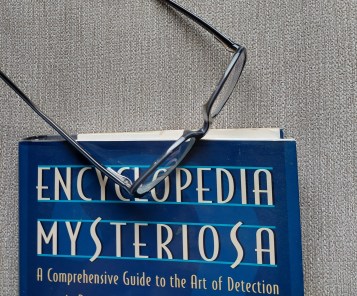
 Writers don’t work in a vacuum. If they’re to create well-written stories or works of non-fiction, writers often need to do some background research (e.g. Is there really a pizza place at the end of that street? How long does it take for Monarch butterflies to emerge from their cocoons?). And it’s not just research questions, as important as they are. Writers also get inspiration from things and people they see, and sometimes places they go. Ask any writer. That’s why it’s especially interesting when you see that creative process in fictional writers. And there are plenty of them in crime fiction.
In Agatha Christie’s Death in the Clouds for instance, a group of people board a plane from Paris to London. One of those passengers is detective novelist Daniel Clancy. During the flight, he’s making notes for a story he’s writing, and consults a railway timetable he’s brought to create a series of alibis. He’s so wrapped up in what he’s doing that he doesn’t notice that one of his fellow passengers has been murdered. In fact, nobody seems to have noticed that Marie Morisot, a French moneylender, is dead. In fact, her death isn’t discovered until a steward tries to wake her. Mr. Clancy and the other passengers are the only possible suspects, and Chief Inspector Japp starts right away to try to work out who the killer is. Hercule Poirot happened to be on that flight, so he works with Japp. More than once, he has a conversation with Mr. Clancy, and we learn how Clancy does his research, and how he’s inspired. I know, fans of Ariadne Oliver! You’re absolutely right about Hallowe’en Party.
Dorothy L. Sayers’ Harriet Vane is a mystery novelist, too. When we first meet her in Strong Poison, she’s gotten a solid reputation as a crime writer, and is doing reasonably well. She’s been working on her newest novel, which features murder by poison, and she’s been doing research on that topic. That research, and the knowledge she gains from it, turn out to be damning evidence against her when her former lover, Philip Boyes, is murdered – by the very poison she’s been researching. She had broken things off with Boyes, and it’s not a far leap to believe she killed him. When she is arrested and tried for murder, Lord Peter Wimsey attends the proceedings. He becomes infatuated with her and determines to clear her name so that they can marry. He gets his chance after the jury is unable to return a verdict. It’s an interesting case of what happens when a crime writer’s research has an all too real connection.
P.D. Martin’s Fan Mail, FBI profiler Sophie Anderson gets the chance to meet bestselling crime novelist Loretta Black when Black visits the FBI on a research trip. The author doesn’t make a very good impression, but she does get the information she wants for her upcoming book. Not long afterwards, Loretta Black is found murdered in an eerie imitation of the murder in her latest book. The investigation into that murder has just gotten underway when there’s another murder, again of a crime writer. And once again, the victim is killed in the same way as her fictional victim is killed. Now, Anderson suspects someone may be targeting crime writers. If so, why? If not, what else do the victims have in common?
Lynda Wilcox’s Verity Long serves as personal assistant for famous crime writer Kathleen ‘K.D.’ Davenport. Her main task is to research real-life unsolved crimes. That’s the material from which K.D. gets her inspiration for the plots of her books. Verity reads books, archived news articles, and so on to find those stories. When one of them strikes her as something her boss can use, Verity brings it to K.D.’s attention. Then they decide if it’s good fodder for a story. Part of the process of research is talking to people related to the cases to get their perspectives (and, where appropriate, their permission). Not only does Verity find out background on a lot of interesting cases, but she also ends up getting drawn into mysteries that some people don’t want her to solve.
And then there’s Betty Rowlands’ Murder at Hawthorn Cottage. Crime writer Melissa ‘Mel’ Craig has taken a cottage in the Cotswolds. She’s just ended a relationship, and wants a new start, as well as to work on her new book. She’s got deadlines to meet, and she wants to focus on them. She’s got some background material and wants to get the book written. Everything changes when she gets a call from a stranger who thinks she’s someone called Babs. The caller is insistent and persistent, and before long, Mel is drawn into a case of a missing young woman. As the story goes on, we follow as Mel gets inspiration from the location, uses that in her work, and creates the story.
Writing a novel is a lot more than just getting an idea and jotting it down. It does often start with inspiration, but it also requires doing research, getting background details, talking to people, and a lot more. All that behind-the-scenes work can result in a fine novel, but it doesn’t happen magically. And it’s not always safe. Just ask any fictional author!
*NOTE: The title of this post is a line from John Denver’s Calypso.
 Crime Writer Margot Kinberg
What an interesting post, Margot. I have read the Christie book and the Dorothy Sayers book, and remember how research almost got those characters in trouble. The others are new to me.
I love that that you included the photo of Encyclopedia Mysteriosa at the top of your post. I love that book and have two copies of it, one hardcover, one trade paper.
LikeLike
Encyclopedia Mysteriosa is a great resource, isn’t it, Tracy? A friend gave it to me, and I’ve been very grateful for it. Thanks for the kind words about the post; I’m glad you found it interesting. You’re right, too; it’s funny how deeply into trouble you can get with research, especially in a crime novel…
LikeLike
Wanted to say that Calypso is absolutely gorgeous song! That chorus soars.
LikeLike
I really love Calypso too, Sorry31. You’re right about the chorus; it’s amazing.
LikeLike
I recently stumbled upon your blog and truly admire your style.
LikeLike
Thank you very much, Marius.
LikeLike
You know, I’d forgotten that Harriet Vane was an author. Strong Poison was the first LPW I read oddly enough, having been told by someone to start there rather than with book one. I’m still not sure whether that was good advice because when I eventually went back to read the earlier books I really liked them. In fact, I think Clouds of Witness is my favourite LPW except for the book of all the short stories I have.
LikeLike
I know Harriet Vane is a popular character, Cath, and perhaps people prefer the novels that feature her? At any rate, Whose Body? and Clouds of Witness have some interesting puzzles in them. I’m glad for you that you enjoyed them so well.
LikeLike
Ah, I love Harriet Vane – such a wonderful creation! But I had forgotten Clancy – it’s a while since I read “Death in the Clouds”. You’ve rather made me want to revisit it!!
LikeLike
Isn’t Harriet Vane a great character, KBR? And really quite modern of DLS, as I see it. As for Mr. Clancy, I loved the way Christie used him to poke a bit of fun at detective novelists. If you do get the chance to re-read Death in the Clouds, I hope you’ll enjoy your reunion!
LikeLiked by 1 person
Yikes. Imagine being killed off in the way your fictional character dies. Terrible stuff, but it certainly makes for great fiction! Research is the toughest part of writing a novel really. It can be interesting though. Some novels are just waiting to be written.
LikeLike
That’s true, OP. Some novels really are waiting, just from the interesting stuff out there. Research can be hard, and it’s painstaking too, if you want to do it right. It may take time, but I much prefer a well-researched one to a sloppy one.
LikeLiked by 1 person
This reminded me of my reading of Joseph Knox’s modern crime stories, which are set in the major UK city of Manchester. I thought they were excellent, and was convinced my brother would like them – all the more so because he lives in Manchester. He told me how much he enjoyed them, and he read them all. But he did also say ‘the detective goes to a pub: it’s a real one, and I visit it. And it wouldn’t have been open on the day/date/time he mentions…’
I don’t know whether that makes him a bad reader or a good reader from the writer’s point of view. But he’s certainly an encouragement to do your research!
LikeLike
That’s exactly what I had in mind with this post, Moira! You really do have to be accurate when you’re writing. People do notice it when you’re not correct about things like where a major building is or when a certain person played for a certain team. It’s part of making a story ring true, I suppose. And thanks for mentioning Joseph Knox. I need to read his work!
LikeLike