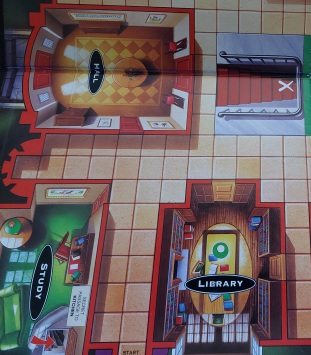
 In Agatha Christie’s The ABC Murders, Hercule Poirot and Captain Hastings have a conversation about what the ‘perfect’ murder case might be like. For Hastings, it’s the traditional sort of case where a dead body is found in a library and there’s an unusual weapon. This scenario will be familiar to Christie fans who’ve read The Murder of Roger Ackroyd. Poirot disagrees about the ‘perfect’ murder case, dreaming of something else:
‘It must be – he waved his hands excitedly – ‘something recherche – delicate – fine.’
He doesn’t have in mind an ‘ordinary’ murder, and he and Hastings certainly don’t get one in the novel. In fact, they’re faced with a very difficult case as they and Chief Inspector Japp go up against an unusual multiple murderer.
If you’re a crime fiction fan, you probably have your own idea of what makes for a made-to-order case. Some readers, for instance, like ‘impossible’ murders. For those readers, trying to figure out how a murder was committed is as intriguing as working out who the killer is. Edmund Crispin’s The Gilded Fly and The Moving Toyshop are two examples of those kinds of murders. So is Tom Mead’s Death and the Conjurer. In that novel, famous psychiatrist Anselm Rees is found dead in his locked study. There doesn’t seem to be a way for anyone to have gotten in or out of the room. Yet, it’s not a suicide. So how was the deed accomplished? It takes former magician and amateur sleuth Joseph Spector to put the pieces together. Spector also features in The Murder Wheel and Cabaret Macabre.
‘Locked room’ and ‘impossible’ mysteries aren’t for everyone. Some people, for example, prefer the ‘country house’ sort of crime novel. In those stories, a group of disparate people gathers, sometimes for a celebration. Often (not always), one of the guests is a police officer or an amateur sleuth. During the gathering, one of the guests dies. Sometimes there are other deaths, too. Kalpana Swaminatham’s The Page Three Murders is like that. In the novel, Dr. Hilla Driver has inherited a posh home, and wants to have a weekend house party to show it, and to celebrate her niece Ramona’s eighteenth birthday. Several famous people have been invited, and Hilla’s chef Tarok Ghosh wants to use the opportunity to make an unforgettable feast that will put the home on the culinary map. Everyone gathers, and the weekend starts. On the second night, Tarkok serves a seven-course meal that begins with a custom-made appetizer for every guest. Those appetizers are not just gourmet food, though; they are hints to the guests of a secret Tarok knows about each one. And that knowledge ends up getting Tarok killed. One of Hilla’s guests is former Mumbai police detective Lalli, and she and her niece work to find out who the killer is. There are many other ‘country house’ murders, too. Georgette Heyer wrote a few, and A.A. Milne’s The Red House Mystery is another example.
Maybe you prefer the ‘village’ sort of mystery. These usually take place in a small, sometimes rural, town or village. Everyone knows everyone, and there are usually past secrets that people keep. Sometimes the sleuth is a resident of the town; other times, the protagonist is a police detective who’s called in to investigate. These stories run the gamut from light to very bleak noir stories and can take place in almost any small town in the world. Caroline Graham’s Tom Barnaby novels are like this. Quite often, Barnaby and Sergeant Gavin Troy investigate in their own town or nearby towns (Midsomer Murders, anyone?). Jinny Alexander’s Jess O’Malley novels also feature the small-town setting. Jess lives in the Irish town of Ballyfortnum, where she works part time in the local garden shop. She and her partner, police detective Marcus Woo, know everyone in town, and they all know Jess and Marcus. It’s a small community with a history, and that comes through in the novels. Graham Norton’s Holding is also a small-town crime novel, but with a darker, less optimistic tone. There are many, many other examples, too – far too many for me to list here. I know, fans of Louise Penny’s Three Pines series – you’re absolutely right!
There are also crime fiction fans who are partial to the ‘old remains are found’ sort of crime novel. In these novels, an old set of bones is found. Sometimes the protagonist finds them; sometimes the protagonist helps to identify them and thus, solve the case. Fans of Elly Griffiths’ Ruth Galloway series know that she is a forensic anthropologist who’s often called in when unidentified remains (especially very old ones) are discovered. There’s also Keithy Reichs’ Temperance Brennan series. Brennan is also a forensic anthropologist who is called in when her expertise is needed. Of course, the protagonist in these sorts of stories doesn’t have to be a forensics expert. The plot in Cathy Ace’s The Wrong Boy revolves around a set of human remains that are discovered near the small Welsh village of Rhoseddraig. Detective Inspector (DI) Evan Glover is on the point of retiring, but he can’t resist the urge to find out who the dead person was, and how and when the death occurred.
There are other scenarios, too, that appeal to a lot of people. And that’s part of the beauty of crime fiction; it comes in lots of shapes. Which sort of fictional murder setup appeals the most to you?
*NOTE: The title of this post is a line from Don Harris and Dewey Terry’s Leaving it Up to You.
You decide what you’re gonna do
 Crime Writer Margot Kinberg
I like anything to be honest, although locked room is not a favourite. I like foreign or exotic settings, I expect you guessed that, LOL, especially the USA and Italy, but anywhere really. The discovery of old bones is also a favourite so of course I’m a big Elly Griffiths fan, I’ll look up The Wrong Boy in a moment. Oddly enough my Saturday night viewing tonight was the David Suchet version of The ABC Murders. I love a good coincidence.
LikeLike
Oh, that *is* an interesting coincidence, Cath! That one, in my opinion, is a solid adaptation, too (and I’m a purist when it comes to adaptations). I really hope you’ll like The Wrong Boy. I think Cathy Ace is a very talented writer. And as far as Elly Griffiths goes I think she’s brilliant; I’ve not been disappointed in any of her novels that I’ve read. You have an interesting point about foreign/exotic locations; I think a lot of people like to imagine places they’ve never been.
LikeLike
Some lovely types of crime novel, Margot, and I’m fond of most. I do love a good locked room or country house one, but my favourite might be the kind of mystery that delves into past events – Christie was particularly good at those and they’re always a treat!
LikeLike
Thanks, KBR! I really enjoy a past/present sort of mystery, too! It gives the reader the chance to experience two timelines and two plots, if I can put it that way, and that adds to the richness. And you’re right; Christie really was especially good at those!
LikeLiked by 1 person
I’m torn between the country house and the village/small town settings. Village settings are often on the cosy side these days, but older authors seemed to see them as darker places, full of repressed secrets and passions – my type of place, fictionally of course! Impossible crimes only work for me when they don’t overwhelm the plot – I still need suspects, motives, human nature, etc., to fill out the puzzle element.
LikeLike
I know what you mean, FictionFan, about ‘village’ murders. They do best when there’s underlying tension and suspense. Dark secrets and shady doings help too! Country house can work well, too, again, if there’s solid underlying suspense. As for ‘impossible’ crimes, I think they’re best if they’re not too – is self-absorbed the term? – so as to pull attention away from the characters and so on. But then, I think characters matter when it comes to a good crime novel.
LikeLiked by 1 person
Of the four types you mentioned above, I am partial to country house mysteries although village mysteries are just fine too.
I have always liked police procedurals but there is so much variation in that type of mystery that it really depends a lot on the author.
LikeLike
You have a strong point, Tracy. There are so many kinds of police procedurals that it’s hard to say that they’re all good. But some of them are excellent, so I can see why you like them. And country house and village mysteries often have a really effective sense of atmosphere and characters.
LikeLike
I have strong views, though always willing to break my rules for a good story!
Likes – and I know we have discussed this before: I love books set in theatres, schools, universities and convents. I’ve recently added department stores to that list, and I also like a good office settting.
For me – and this is obviously just personal opinion – I’m not so keen on inverted mysteries, serial killers, and books where the perpetrator was just mad.
Those give me plenty of books to read – and as I say, I can be persuaded to read something outside my comfort zone.
LikeLike
I like those settings, too, Moira. I’m not sure exactly why, they do seem so good for a crime novel. It’s a shame we don’t have those old-fashioned department stores anymore. They really had their own personalities, and so good in a novel.
Like you, I’m not one for serial killers and novels where the culprit is simply mad. Not that that hasn’t happened, but it just doesn’t make for as engaging a story most of the time. But, as you say, if the book is really, truly excellent, then I’ll bend the ‘rules,’ so to speak!
LikeLike