The Mob Moves Like Demons Possessed*
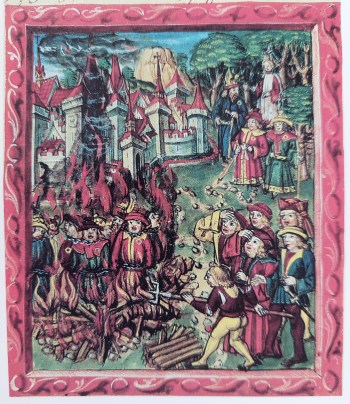 When a belief catches hold, it can sway a large group of people. Sometimes, that can be a very good thing, but sometimes, it can lead to what’s often called a ‘witch hunt.’ And that can mean that lots of innocent people (or sometimes just one innocent person) will pay a heavy price. We’ve seen this a great deal throughout history, so it’s no surprise that it’s woven into crime fiction as well.
As Ariana Franklin, Diana Norton wrote a four-novel historical series featuring Adelia Aguilar. She’s a 12th Century doctor – a ‘mistress of the art of death’ who’s traveled from Salerno to England at the request of King Henry II. In the first novel, Mistress of the Art of Death, the king is concerned about a series of gruesome deaths. Word has gotten around that the Jewish community is responsible, and many people believe it’s true. And plenty of people want to track down and kill anyone Jewish. The king fears that there’ll be a massacre, and he wants to forestall that with a proper explanation of what really happened. Since Adelia is a woman, she can’t legally work as a doctor in England, so she and her assistant Mansur pretend that he’s actually the doctor. Together, they get to the truth of the matter.
During the Cold War between the UK, the USA and their allies, and the USSR and its allies, there was a great fear of communism. It culminated in the McCarthyism and ‘witch hunts’ of the 1950s, but it didn’t start then. We see this in action in Agatha Christie’s Hickory Dickory Dock. In the novel, Hercule Poirot works with Inspector Sharpe to find out who murdered Celia Austin. She lived in a hostel for students, so Poirot and Sharpe investigate the other residents. As they do, they find things out about all of the people who live there. During their interviews, there’s an interesting conversation about the ‘hysterical’ fear of communism. And in fact, one of the residents turns out to be a member of the party. It’s an interesting look at the way people felt about communism at the time.
There’s another look at that fear of communism in Walter Mosley’s A Red Death. Ezekiel ‘Easy’ Rawlins is a former aircraft factory worker who was let go from his job. Now, he’s an informal private investigator who ‘does favors.’ He’s good at finding people who don’t want to be found. One day, he receives a threatening letter from the Internal Revenue Service. The letter claims that he owes thousands in back taxes and will go to prison if he doesn’t pay. Rawlins can’t afford that kind of money, so he’s expecting a prison sentence. Then, there’s a ray of hope. An FBI representative offers to make Rawlins’ tax problems go away if he’ll help bring down former Polish Resistance fighter Chaim Wenzler. It’s believed that Wenzler is a communist, and the FBI wants proof. Rawlins doesn’t see that he has much choice, so he agrees to the deal. As he gets to know Wenzler, though, he begins to feel an affinity for the man, and he’s no longer sure he wants to be a part of the FBI’s plan. Now, he’s torn between his feelings and the deal, and matters don’t get any better when he’s framed for two murders…
William Ryan’s Captain Alexei Korolev series takes place mostly in Moscow during the years immediately before (and leading into) World War II. Korolev is part of Moscow’s criminal investigation team, and the job is a very difficult one. These are the years of Stalinism, and anyone perceived as being less than enthusiastic about communism and Stalin is considered a traitor and dealt with accordingly. People are encouraged to spy on and denounce others, even family members, and there is a general movement to root out anyone who’s not ‘patriotic’ enough. Part of the government’s message to the world is that under communism, there is no crime. So, Korolev and his colleagues are expected to do whatever they have to do in order to present a picture of an orderly society. When there is a murder, Korolev must move very quietly and be extremely cautious about everything he says and does. Anyone could denounce him to the authorities.
Sometimes, ‘witch hunts’ target a specific person or family. That’s what happens in Jennifer Lane’s Miracle. Deborah ‘Miracle’ Jamieson and her family live in the small Australian town of Boorunga. When Miracle’s father Jim loses his job as a postman, he looks around for work and finally finds a job at the local crematorium. The locals are suspicious of the place, believing it responsible for poisoning the water and causing several deaths. The Jamieson family has its own issues, too. Miracle’s mother Henrietta has had emotional and mental challenges since an earthquake struck the day Miracle was born (hence, her nickname). Miracle’s brother Julian was also impacted by the quake and now has learning and other difficulties. All of this has meant some of the locals regard the Jamiesons as ‘strange.’ So, when a boy is brutally attacked, it’s not a far leap for everyone to assume that Jim Jamieson was responsible. In fact, he’s arrested, and the whole town turns against him and his family. Miracle doesn’t believe any of it, though, and she’s determined to find out what really happened.
There are plenty of other examples of the way ‘witch hunts’ can turn people against each other. The consequences of not thinking independently can end up in mob action. It does in crime fiction, and it does in real life.
*NOTE: The title of this post is a line from Rush’s Witch Hunt.
 Crime Writer Margot Kinberg