But When I Want Sincerity, Tell Me Where Else Can I Turn?*
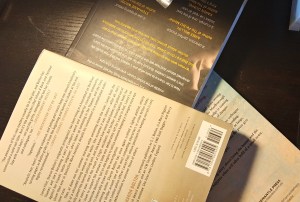 A recent meeting of the book club I belong to has got me thinking about blurbs. The book that we were reading turned out to be quite different to what was described in the blurb, and that was a problem for several members of the club. And it highlighted some of the challenges of book blurbs.
I think most crime fiction fans want to know something about a book before they decide to read it. Among other things, they may want to know, for instance, how gritty a story is, whether a book has a lot of violence, or whether it deals with certain topics. Readers also want to know what sort of story they’re getting (e.g., police procedural, noir, historical mystery, or something else). After all, we all have different tastes. So, it is important to be truthful in a blurb; that’s how readers decide what to read.
That said, blurbs are meant to sell. So, they often contain descriptions or adjectives (like ‘gritty,’ ‘lighthearted,’ ‘suspenseful,’ or ‘hair-rising’) that make some readers sit up and take notice. They are, after all, advertisements for a book, so it makes sense that they would tout the book’s features.
The challenge is balancing telling the truth about a story with making that story sound irresistible to as many people as possible. And that can be tricky.
Here, for instance is a blurb for Agatha Christie’s Murder on the Orient Express:
‘’The murderer is with us—on the train now . . .’
Just after midnight, the famous Orient Express is stopped in its tracks by a snowdrift. By morning, the millionaire Samuel Edward Ratchett lies dead in his compartment, stabbed a dozen times, his door locked from the inside. Without a shred of doubt, one of his fellow passengers is the murderer.
Isolated by the storm, detective Hercule Poirot must find the killer among a dozen of the dead man’s enemies, before the murderer decides to strike again.’
Fans of the novel will know that the facts laid out in the blurb are true. Is this blurb accurate? Does it have too much ‘hype?’ It certainly uses compelling language.
Here’s the blurb for James M. Cain’s novella, Double Indemnity:
Walter Huff was an insurance salesman with an unfailing instinct for clients who might be in trouble, and his instinct led him to Phyllis Nirdlinger. Phyllis wanted to buy an accident policy on her husband. Then she wanted her husband to have an accident. Walter wanted Phyllis. To get her, he would arrange the perfect murder and betray everything he had ever lived for.
This blurb has the advantage of being short, and of not revealing too much about what happens in the novel. It doesn’t give specific information about the story’s sub-genre, but it’s not hard to tell from the description that things are probably not going to go well for these people.
The thing about blurbs, too, is that they can’t be too wordy. Otherwise, people won’t read them, and likely won’t be interested in the book. So, sometimes a blurb has to leave out important story arcs and sub-plots. For instance, here is the blurb for Reginald Hill’s Child’s Play, the ninth in his Dalziel/Pascoe series:
Gwendoline Huby’s passing has left her relatives more aggrieved than grieving. The wealthy and dotty widow has bequeathed the bulk of her fortune to her son, Alexander, missing in action since World War II. Then a stranger appears at the funeral claiming, against all odds, to be the phantom benefactor. Imposter or rightful heir? For Dalziel and Pascoe, a prickly situation is made even more so when Alexander is murdered. But when a second body turns up—this time in the CID’s parking lot—the Yorkshire detectives can’t fathom a connection. Until they dare to look a little deeper into the Hubys’ family plot.
This blurb certainly gives solid facts about the main case that Dalziel and Pascoe investigate. And that in itself will attract readers, especially those who already like the series. But it leaves out a very important sub-plot about Sergeant Wield, who’s a valuable member of the investigating team. Should that sub-plot be in the blurb? Would that be too much? It’s an interesting example of how a blurb has to balance telling the story with not telling every detail.
We also see that balance in the blurb for Louise Penny’s Still Life:
Chief Inspector Armand Gamache of the Surêté du Québec and his team of investigators are called in to the scene of a suspicious death in a rural village south of Montreal. Jane Neal, a local fixture in the tiny hamlet of Three Pines, just north of the U.S. border, has been found dead in the woods. The locals are certain it’s a tragic hunting accident and nothing more, but Gamache smells something foul in these remote woods, and is soon certain that Jane Neal died at the hands of someone much more sinister than a careless bowhunter.
This blurb uses language such as sinister and foul to add to the ‘draw’ of the book. But if you look at the description, it’s a fairly accurate summary of the main plot point – the death of Jane Neal and the first trip Armand Gamache makes to Three Pines. It doesn’t mention any of the sub-plots in the story, but again, there’s value in some brevity.
It’s not easy, really, to write an effective blurb for a book. It’s got to be truthful, but exciting. It’s got to be informative, but not overburdened with detail. It’s got to be noticeable, but not melodramatic. But what do you think? Where do blurbs fit in with your reading choices? If you’re a writer, how do you handle writing them?
*NOTE: The title of this post is a line from Billy Joel’s Honesty.
 Crime Writer Margot Kinberg