It’s Your World Now*
 Some fictional characters become so beloved that, even after their creators have passed away, others write new mysteries featuring those characters. These follow-on stories can be interesting, and they certainly add to the characters’ stories. That said, though, there are plenty of people who don’t care for follow-ons and believe the characters should be allowed their rest.
There’ve been several follow-ons to Arthur Conan Doyle’s Sherlock Holmes stories, and that’s not surprising, considering what a popular character he’s been for nearly 140 years. I’ll only mention one here, but I’m sure you’ll be able to think of others. In S.F. Bennett’s Sherlock Holmes: The Addleston Tragedy, Holmes and Watson get a visit from Holmes’ cousin, Peregrine Holmes. Peregrine is an antiquarian and amateur historian whose work has come to the attention of renowned professor Horace Mountjoy. In fact, Mountjoy invited Peregrine to visit his barrow excavation near the small town of Addleston. Almost immediately, though, eerie things began to happen. Then, Mountjoy was found killed. Peregrine wants his cousin and Dr. Watson to travel to Addleston to investigate. What they find is hostile local residents, strange occurrences, and real danger. Some people think it’s all got a supernatural explanation, but Holmes doesn’t believe it, and he and Watson work to find out the truth.
Another beloved fictional character is Agatha Christie’s Hercule Poirot. Christie herself didn’t envision Poirot living after her death, so she wrote Curtain to forestall that possibility. However, matters haven’t stayed that way. Poirot is too popular to stay quiet for long. The Christie estate sanctioned Sophie Hannah to write some follow-on novels, beginning with The Monogram Murders. In that novel, Poirot and Inspector Catchpool solve the murders of a group of people who were found dead in their hotel rooms, with a monogrammed cufflink in their mouths. That clue, plus a cryptic note, are all that Poirot and Catchpool have to go on at first, so it’s a complex case. In the end, though, Poirot finds out the truth. These novels have gotten very mixed reviews; most people seem to either very much like them…or not.
Jill Paton Walsh has written several follow-ons to Dorothy L. Sayers’ Lord Peter Wimsey novels. He and Harriet Vane are beloved by millions of crime fiction fans, so it’s not a surprise that they’d be continued by another author. A well-known and talented author of her own works, Walsh based her Lord Peter Wimsey stories on unfinished manuscripts, notes, and other information from Sayers’ files, so the stories are more than just inspired by Sayers’ work. Walsh’s own style isn’t the same as Sayers’ was, so some of the responses to her follow-on stories have been mixed. Still, her work has generally been praised, and it does keep to Sayers’ conception of tone, atmosphere, and character development.
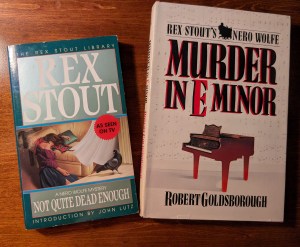
Rex Stout’s Nero Wolfe stories also become extremely popular, leading to several film and television adaptations. There are Nero Wolfe societies, too, and the fictional character has become one of the mainstays of the crime-fictional world. So, it shouldn’t be surprising that, after Stout’s death, there would be several follow-on stories. Perhaps the best-known follow-ons are the work of Robert Goldsborough, who was authorized by the Stout estate to continue the series. One of his novels is Murder in E Minor. In it, we meet Milan Stevens, well-known conductor of the New York Symphony. He’s been getting death threats, and he asks Wolfe to find out who’s responsible. At first, it doesn’t seem that Wolfe will take the case, but he does. Not long after the investigation begins, Stevens is stabbed. Now, Wolfe and Archie Goodwin have to consider a group of suspects, since there was more than one motive for Stevens’ murder. There are now eighteen Nero Wolfe books by Goldsborough, and they’ve had a generally positive reception.
Tony Hillerman created the Joe Leaphorn/Jim Chee novels that take place in the American Southwest, mostly on and near the Navajo Reservation. Fans of this series will know that both men are members of the Navajo Nation and the Navajo Tribal (now Nation) Police. The books became very popular, and Hillerman won international acclaim for his work. Five years after his 2008 death, his daughter Anne continued the Chee and Leaphorn stories that also include Chee’s wife, Bernadette ‘Bernie’ Manuelito. Beginning with Spider Woman’s Daughter, the Anne Hillerman follow-on series now includes ten books. It’s had positive reception on several points (e.g. portrayal of the land and people and respect for the indigenous culture). On the other hand, some Tony Hillerman fans are not as pleased with some of the pacing in her stories. Still, her series has been, overall, well received.
The question of follow-ons is complicated. Some argue that it makes sense to continue beloved characters. And, let’s be honest, it can be financially beneficial. Others, though, say that once the original authors have gone, it’s time for their characters to do so, too. Besides, each author has a unique style and insight, and follow-ons won’t capture that. It’s not a settled issue. What do you think? Do you read follow-ons? What do you think of them?
*NOTE: The title of this post is the title of a song by the Eagles.
 Crime Writer Margot Kinberg