She Made Hats For the Lucky Ones*
 As times have changed, so have people’s needs. In turn, so have certain occupations. For instance, when was the last time you had to go to a blacksmith? There still are people who do smithing, but it’s very rare. The same is true for other occupations, too. Just a quick look at crime fiction shows some of the trades that are much rarer than they were.
For instance, in Cornell Woolrich’s Night Has a Thousand Eyes, New York Homicide Detective Tom Shawn saves a woman from committing suicide one night. He takes her to an all-night restaurant where she tells him her story. She is Jean Reid, only child of wealthy and successful Harlan Reid. Up until recently, her life was a good one, but things have taken a darker turn. It seems that her father took a business trip to San Francisco. The Reids’ maid warned her that her father would suffer a terrible fate if he returned at the time he planned. Then, the flight he was supposed to take crashed, leaving no survivors. Miraculously, Harlan Reid didn’t take that flight. When he returned from San Francisco, he told Jean that he got a telegram warning him to change his plans. Jean knows she didn’t send that telegram, and finally, the housemaid admits she sent it. She then tells the Reids about a man called Jeremiah Tompkins, who is cursed with the ability to see the future. He’s predicted Harlan Reid’s death, and Jean is terrified his prediction will come true. Tom Shawn agrees to see if there’s some way he can protect Harlan Reid. Soon, he gets drawn into a bizarre mystery – and a murder. In this novel, telegrams are used in a few places, and they were common at the time. Today, they’re still used for a few specific purposes, but they’re far less common than they were.
Agatha Christie’s The Clocks features the Cavendish Secretarial and Typing Bureau, owned and managed by Katherine Martindale. She employs a group of young women who type up academic papers, novels, contracts, and so on. Some of the work is sent into the agency, and in some cases, the young women go out to clients. That’s the case one day when Sheila Webb is especially requested to go to the home of Millicent Pebmarsh. When she gets there, she is shocked to find the body of an unknown man in the sitting room.. Frightened, she rushes out of the house and collides with a man called Colin Lamb, who has his own reasons for being there. Both soon find themselves embroiled in a case of murder, espionage, and more. Individual people may have assistants who do the paperwork, and there are freelancers who do that work. But most writers type up their own work. Trust me. A lot of academics do, too. There aren’t typing bureaus the way there used to be, and they’re far more likely to use computers and virtual imagery than typewriters.
Shona (S.G.) Maclean’s The Redemption of Alexander Seaton takes place in 1626 Banff, Scotland. Alexander Seaton is a former candidate for the ministry who now serves as undermaster for the local grammar school. One day, he is shocked to find the body of the local apothecary’s assistant, Patrick Davidson, in his classroom. Soon enough, Chrles Thom, the local music teacher, is arrested. It’s believed that he killed Davidson because they were romantic rivals. But Thom tells his friend Seaton that he’s innocent. He begs Seaton to help clear his name, and Seaton agrees. As a part of his search for the truth, Seaton visits Edward Arbuthnott, the apothecary and Davidson’s employer. He also speaks to Arbuthnott’s daughter, Marion, to find out what she may know. It’s a tangled case and it puts Seaton in danger. It’s also a look at the apothecary’s business. Today, most people get their medications from pharmacies and, occasionally, from doctors, and traditional apothecary work has been taken over by pharmacists. But apothecaries were quite common in centuries gone by.
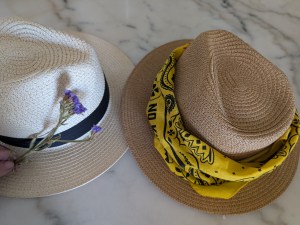
Except for protection from the elements, or for religious reasons, people don’t generally wear hats. And even those who do sometimes wear a hat tend to buy them in clothing stores or online. But it used to be the case that just about everyone wore a hat. Some were simple, some elaborate, but hats were as much a part of an outfit as footwear or a jacket. And hats were made by milliners. A skilled milliner could fashion a hat that was uniquely suited to its wearer, and their creations were extremely popular. D.S. Nelson’s Blake Heatherington had his own millinery shop in London, where he matched every client to exactly the hat that would best suit that person. He took pride in his work, too. But now that he’s older, he’s sold up his business and moved to the small town of Tuesbury. He still makes hats to order (Shhh, don’t tell the Council he has a business on his property!). And he has a way of getting involved in cases of murder. His fondness for his work is an important part of his personality. I know, fans of Agatha Christie’s Lord Edgware Dies – there’s a milliner in that novel, too.
Another occupation people used to have was door-to-door selling (e.g. the Fuller Brush man, the Avon lady). Companies would send sales representatives around with samples or inventory, and those people would travel around, selling the products. You could buy anything from vegetables to stockings that way. And there are still people who do a little of that. For example, in my community, there’s a woman who makes and sells homemade tamales door-to-door. But in general, if you want to buy something today, you go to the place that sells it, or you order it online. It wasn’t always that way, though, We see an example of that in L.R. Wright’s The Suspect. The story begins just after eighty-year-old George Wilcox kills eighty-five-year-old Carlyle Burke. He leaves the scene of the crime, then returns a bit later and calls the police. RCMP Staff Sergeant Karl Alberg takes the case and begins to investigate. He soon learns that a fisherman had stopped, as per usual, to sell his catch door-to-door. And at first, Alberg suspects that man is the killer. But he is soon cleared, and Alberg turns his attention to Wilcox. The question is, what’s the motive? It’s an interesting case of knowing who the killer is right from the beginning. And it shows how door-to-door selling works. I know, fans of Agatha Christie’s The ABC Murders. Door-to-door selling is important in that story…
There are other professions, too, that you don’t see much of (if at all) anymore. It shows how society changes. It also shows how crime fiction documents those changes.
*NOTE: The title of this post is a line from Beccy Cole’s The Milliner.

