Singing Songs and a’Carryin’ Signs*
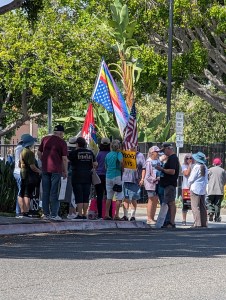 I think we’d all agree that there are plenty of societal wrongs that need to be righted. So, we donate, or we volunteer for a cause, or we find some other way to pitch in. Some people are thoroughly devoted to a cause and work at it full time or nearly so. That activism can be dangerous, but even when it’s not, activists are often very passionate about their causes. And that trait can make them interesting characters. In crime fiction, activism can lead in a lot of different directions…
In Agatha Christie’s One, Two, Buckle My Shoe (AKA The Patriotic Murders and An Overdose of Death), we are introduced to Howard Raikes. He is an activist and, so many people think, a radical, who wants society to be completely changed and made more equitable. He’s involved with Jane Olivera, whose uncle, Alistair Blunt, is a rather conservative banking tycoon, who has a much more cautious approach to any change. Raikes has butted heads with Blunt and those like him before. One day, Blunt goes to his dentist, Henry Morley. Later that morning, Morley is found dead in his office. One appealing theory is that Blunt was the real target. As you can imagine, Raikes becomes a suspect when it’s found that he was actually at the office building on the morning of the murder. Hercule Poirot was also there, so he works with Chief Inspector Japp to find out who the killer is, and what the motive is.
Scott Young’s Murder in a Cold Climate is the first of his two novels featuring Matthew ‘Matteesie’ Kitologitak of the RCMP. The real action in the novel begins as he waits at the airport in Inuvik for a flight that will eventually take him to Ottawa, where he lives. The plane arrives and Matteesie boards, along with a few other people. One of those other people is First Nations activist Morton Cavendish, who’s on his way to Edmonton for emergency surgery. When the plane arrives at Fort Norman, a gunman forces his way aboard and shoots Cavendish, killing him instantly. Matteesie saw the whole thing, but he doesn’t know who the shooter is or what the motive is. So, he begins to investigate. One good possibility is that Cavendish was murdered by someone who opposes his activism. But that’s not the only possibility, so Matteesie has to look more deeply to find out who’s responsible.
At the beginning of Donna Leon’s Through a Glass Darkly, a group of activists is protesting the dumping of toxic waste into Venice’s water supply. They’ve targeted the city’s glass blowing factories, in particular, the factory of Giovanni de Cal. The leader of the activists is de Cal’s own son-in-law, Marco Ribetti. Naturally, de Cal is furious at the activism, and the police are called. They arrest Ribetti, among others. Ribetti contacts his friend, Ispettore Lorenzo Vianello, for help. Vianello and his boss, Commissario Guido Brunetti, arrange for Ribetti’s release. But that’s only the beginning of the story. Not long afterwards, Giovanni de Cal’s night watchman, Giorgio Tassini, is killed in what looks like a tragic accident. But was it? And if it was murder, might Ribetti or one of his fellow activists be responsible? Brunetti and Vianello have to peel away more than one layer to find out the truth.
In Gail Bowen’s Kaleidoscope, we meet Riel Delorme, a Regina-based Métis activist. He and his group, the Warriors, are strongly opposed to any development in the city, because they believe it will disenfranchise people who are already struggling. This brings Delorme right up against a development company that wants to operate in the area. When one of the company’s employees is killed, Delorme and his group fall under suspicion. It’s all especially hard for political scientist and professor Joanne Kilbourn Shreve, because her attorney husband Zack represents the company. To make matters more complicated, her daughter Mieka has become involved romantically with Delorme. The real solution is to find out who the killer is, so the family won’t be torn apart.
Geoffrey Robert’s The Alo Release features New Zealand environmental activist Jay Duggan, who’s been working with a Los Angeles-based environmentalist watchdog group called the Millbrook Foundation. Lately, the group’s been keeping a careful eye on a company called Vestco, which is planning to release a genetically modified seed that it claims will eliminate hunger. The Millbrook Foundation is suspicious, and wants to prevent the release of this seed, but they’ve not been successful, and the release is scheduled soon. In the meantime, Duggan has decided to retire and return to his home in New Zealand. He invites two Millbrook colleagues to join him for a visit, and they agree. They board their flight from Los Angeles and head to Auckland, not knowing that after the flight took off, Vestco employee Henry Beck was murdered. Duggan and his companions become suspects, and the subjects of an international search. Now, they have to avoid the police, try to stop the release of the seed, and find out who really killed Beck.
Activists don’t always get involved in cases of murder, but they can run into trouble. Still, they are passionate about their causes, and work to improve life. We may get annoyed with them at times, but we also benefit from what they do.
*NOTE: The title of this post is a line from Buffalo Springfield’s For What It’s Worth.
 Crime Writer Margot Kinberg