She Makes Me Wanna Smile All Along the Way*
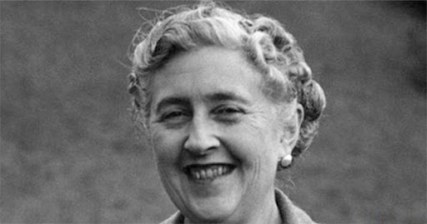 As this is posted, it would have been Agatha Christie’s 130th birthday. That her books are still highly regarded says a lot about her skill as a writer. As you’ll know, she is (rightfully, I think) admired for her plotting. And, while she’s not as famous for her characters, fans know that she created some interesting, even memorable, ones. You might not think about this right away when you think of Christie, but she also had a solid wit that’s woven through her work. It’s not necessarily the laugh-a-minute sort of wit; it’s more subtle. But it’s no less clever for that.
For example, The Murder of Roger Ackroyd is narrated by Dr. James Sheppard, the local GP for the village of King’s Abbot. When one of his patients, retired business magnate Roger Ackroyd, is stabbed, Sheppard gets involved in the investigation. He and Hercule Poirot, who’s taken the home next door to Sheppard’s, look into Ackroyd’s family relationships, his business ties, and his local ties to see who would want him to die. Sheppard has a sort of wry, not always kind, wit that comes through as he talks about the other characters. Here is how he describes his sister Caroline, who is always up on the latest local gossip:
‘The motto of the mongoose family, so Mr. Kipling tells us, is: “Go and find out.” If Caroline ever adopts a crest, I should certainly suggest a mongoose rampant.’
Sheppard isn’t much more charitable in his descriptions of other characters.
Christie sometimes used her wit as she commented on her society. By the Pricking of My Thumbs, for instance, features a middle-aged Tommy and Tuppence Beresford. They get caught up in a mystery involving a care home called Sunny Ridge, where Tuppence’s Aunt Ada lives. When one of the other residents leaves, Tuppence gets curious, although on the surface, it seems like a routine case of someone gone to live with relatives. It turns out that there’s much more to this resident’s departure than that… At the beginning of the novel, Christie discusses being caught between raising children and looking after the elderly – what we now call ‘the Sandwich Generation:
‘For the Aunt Adas of today arrangements have to be made suitable, not merely to an elderly lady who, owing to arthritis or other rheumatic difficulties, is liable to fall downstairs if she is left alone in a house, or who suffers from chronic bronchitis, or who quarrels with her neighbours and insults the tradespeople.
Unfortunately, the Aunt Adas are far more trouble than the opposite end of the age scale. Children can be provided with foster homes, foisted off on relations, or sent to suitable schools where they stay for the holidays, or arrangements can be made for pony treks or camps and on the whole very little objection is made by the children to the arrangements so made for them.’
There’s some truth to that comment, but it’s also witty.
Mrs. McGinty’s Dead takes place mostly in the village of Broadhinny, where James Bentley is due to be executed for the murder of his landlady. Superintendent Albert ‘Bert’ Spence thinks Bentley may be innocent, and he asks Hercule Poirot to investigate. Poirot agrees and travels to the village, where he gets to know some of the residents. At one point, he visits the victim’s home, which has now been bought by someone else. He sees two children outside the house, one of whom is behaving badly. Their mother says to Poirot:
‘“Can’t do anything with children, can you?” the woman said.
Poirot thought you could, but forbore to say so.’
With that one line, Christie shares her opinion on child rearing, and adds in a little wit.
While he’s in Broadhinny, Poirot stays at Long Meadows, which is owned by Johnnie Summerhayes and his wife, Maureen. Although it’s set up as a Guest House, Poirot finds that it doesn’t exactly meet his standards. Nothing works well, his bed’s uncomfortable, and the food is inedible. And there are the loud dogs:
‘A car drove up, the large dog leaped from the chair and raised its voice in a crescendo of barking. He jumped on a small table by the window and the table collapsed with a crash.
“Enfin,” said Hercule Poirot. “C’est insupportable!”
The door burst open, the wind surged round the room, the dog rushed out, still barking. Maureen’s voice came, upraised loud and clear.
“Johnnie, why the hell did you leave the back door open! Those bloody hens are in the larder.”
“And for this,” said Hercule Poirot with feeling, “I pay seven guineas a week!”’
We’ve all been there…
Christie wasn’t afraid to poke fun at her main characters, either. Christie fans know, for instance, that Hercule Poirot does not – ahem – suffer from low self-esteem. In Three Act Tragedy (AKA Murder in Three Acts), Poirot solves the poisoning murder of an inoffensive vicar, Stephen Babbington. It’s not an easy case, and it’s not until Poirot looks at it ‘the right way up’ that he understands how and why the murder occurred. At the end of the novel, he has a conversation with Mr. Satterthwaite, who was present when Babbington was killed. It occurs to Mr. Satterthwaite that he might have become a victim:
“It might have been me.”
“There is an even more terrible possibility that you have not considered,” said Poirot.
“Eh?”
“It might have been me,” said Hercule Poirot.
And, of course, a post on Christie’s wit would not be complete without a mention of her fictional detective novelist Ariadne Oliver. Many people think she used Mrs. Oliver to poke fun at herself and that wouldn’t be surprising. Mrs. Oliver certainly has her eccentricities and foibles, as fans know. But she’s also bright and observant, and is, as Poirot puts it, a very shrewd judge of character. And yet, Christie’s not afraid to make her almost ridiculous at times. It’s an interesting use of wit.
There are plenty of other examples of Christie’s wit in her work. Which have made you smile?
*NOTE: The title of this post is a line from Raf Van Brussel’s She Makes Me Happy.
 Crime Writer Margot Kinberg