I Don’t Practice Santería*
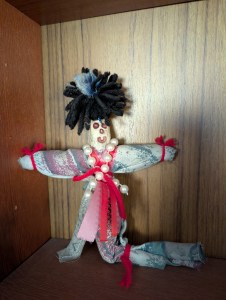 When people think of religion or spirituality, they may think about one of the major faiths (e.g. Christianity, Hinduism, Buddhism, Islam, or Judaism). And there are thousands of references to those belief systems in crime fiction. But there are other, older or less well-known rituals and belief systems that are also a part of the human experience. They may seem exotic, even unsettling, to those who are accustomed to more conventional (if that’s the word) religious traditions. But they are important parts of many people’s history and culture, and it can be fascinating when they appear in crime fiction.
In Agatha Christie’s The Adventure of the Egyptian Tomb, Sir John Willard discovers an ancient tomb during an archaelological dig in Egypt and plans to excavate it. The locals believe that the tomb is cursed, so they want no part of the project. Willard goes ahead with it, though, and the tomb is opened. Shortly thereafter, Willard dies unexpectedly. Then, there are two other deaths. Willard’s widow doesn’t want to seem like the fanciful type, but she is concerned that there might be some truth to the stories about ancient curses. She asks Hercule Poirot to look into the matter, and he and Hastings travel to Egypt. There, they find that even some of those who claim not to believe in the religion of Ancient Egypt have been very unsettled by the events. In the end, Poirot finds out that the killer took advantage of those beliefs to cover up a very prosaic set of murders.
William Hjortsberg’s Falling Angel is the story of Harry Angel, a down-and-out New York PI. One day, he gets a call from the law offices of McIntosh, Winesap and Spy. It seems that one of their clients, Louis Cyphre, wants to find a jazz trumpeter nicknamed Johnny Favorite. Cyphre says that he helped Johnny at the start of his career in return for ‘certain collateral.’ Now, he wants what’s his, but Johnny seems to have disappeared. Angel agrees to find out what he can and begins to look into the matter. It’s not long, though, before things spiral out of control. For one thing, each witness he talks to seems to die shortly after the conversation. For another, at every turn in the investigation, there seem to be elements of ‘black magic,’ Voodoo/Obeah, and other spiritual elements he doesn’t understand. He has strange nightmares, too. It’s soon clear that Harry Angel is into something far deeper and stranger than he imagined.
James Lee Burke’s Dave Robicheaux is a Louisiana police detective. As the series goes on, he encounters more than one instance of the practice of Juju, Voodoo/Obeah, and other sets of beliefs. For instance, in A Morning For Flamingos, Robicheaux is looking for the murderer of a man called Hipolyte Broussard. The main suspect is Tee Beau Latiolais, but he says he’s innocent. The trail leads to Gros Mama Goula, who runs a local brothel. It’s said of her that she is a Juju woman, too. Robicheaux isn’t a believer in Juju, but he does want to know whatever Gros Mama Goula can tell him. During their meeting, she shares some eerie insights into what’s going on in Robicheaux’s mind, and although this isn’t a major part of the novel, it offers readers a quick look at Juju and its appeal to practitioners.
In Martin Cruz Smith’s Havana Bay, Moscow Inspector Arkady Renko travels to Havana when he gets a message that a friend of his, Sergei Pribluda, has gone missing. When a body is pulled out of the bay, the police claim that it’s Pribluda, and that his death was a tragic accident. That could be true, but Renko isn’t completely convinced. When two more murders happen, Renko knows that this is much bigger than an accidental drowning. He works with Havana police detective Ofelia Osario to find out the truth. While he’s in Havana, Renko sees the impact of Santería, an Afro-Cuban religious tradition that developed in Cuba. There’s also the impact of Abakuá, also a Cuban religious tradition. This one is an initiatory religion to which only men can belong. It’s a secret society, too, so many people don’t know who’s a member and who isn’t. And it plays a role in the story.
There’s also Sara Blaedel’s The Killing Forest. In that novel, Louise Rick returns to work with Denmark’s Special Search Agency, part of the National Police, after a medical leave. No sooner has she returned when her department is given a new case. A fifteen-year-old boy, Sune Frandsen, went missing after participating in an ancient Viking ritual in the woods near the small town of Hvalsø. One of Louise’s first steps will be to speak with everyone who was at the ritual to find out what happened and how and when Sune disappeared. But she soon discovers that several of the participants do not want to discuss the ritual; the group is a secret one, and no-one wants to betray the other members. It’s not spoiling the story to say that some of the old, pre-Christian beliefs play a role in the story.
You’ll notice I haven’t included Indigenous religious rituals in this post. To me, that’s another story worthy of its own post. That said, there are a number of older or less well-known belief systems that can impact what people do. Some people find them exotic, while others find them unsettling. Whichever way one feels about it, they’ve found a place in crime fiction.
*NOTE: The title of this post is a line from Sublime’s Santería.
 Crime Writer Margot Kinberg