 Once, many years ago, my husband was on his way home from work when Supertramp’s Take the Long Way Home played on his car radio. Now, my husband isn’t in the least bit superstitious (neither am I), but on a whim, he took a different route home. He found out later that the road he usually took was partially closed and backed up for quite a distance by an accident. My husband and I are both quite prosaic people, but I can’t deny that incident got us thinking.
The fact is, a lot of people get to wondering whether something is a sign or omen, and that makes sense. We want to impose order in our lives, and we want to avoid trouble. For some people, heeding perceived omens helps as they navigate life. Even people who aren’t superstitious wonder sometimes. And for people who do believe in such things, an omen is a powerful message. It happens in real life and in crime fiction.
For example, in Agatha Christie’s The Adventure of the Egyptian Tomb, noted archaeologist Sir John Willard discovers a hidden tomb in Egypt, and plans to excavate it. The locals believe there’s a curse on the tomb, and don’t want the dig to continue. They point to mishaps and deaths that have occurred, calling them omens, but Willard proceeds with his plan. Shortly after the tomb is excavated, Willard dies. Then, there are two more deaths. Taken by themselves, none of the deaths would cause much comment, but Willard’s widow is concerned that there might be some truth in the stories about the curse on the tomb. Hercule Poirot and Captain Hastings travel to Egypt to investigate. They find that someone has used the belief in omens to hide a very prosaic sort of murder.
In Shirley Jackson’s We Have Always Lived in the Castle, we meet Mary Katherine ‘Merricat’ Blackwood, who lives with her sister Constance and her Uncle Julian in an old house in a small New England town. The locals shun the Blackwood family because six years earlier, several other family members died of poisoning, and everyone’s convinced that Constance is responsible. Still, life goes on for the family, and they mind their own business. Then, a cousin arrives unexpectedly, and everything changes. The end result is tragedy. Throughout the story, we get to know Merricat, as the events are told from her point of view. She is more than a little eccentric and has a strong belief in omens. For instance, she believes that seeing other people (vs going some where without seeing anyone) is an omen. So are other occurrences that most of us wouldn’t even think about, let alone see as omens or warnings.
In Petina Gappah’s The Book of Memory, we are introduced to a young woman named Mnemosyne, who is sometimes called Memory, or Memo. We soon learn that she is in prison in Harare, Zimbabwe, for murder. As the story starts, she’s writing a letter to a journalist to explain her side of the story and tell why she is in prison. Her lawyer believes that, with a new government coming to power, there’s a good chance that Memo might escape the death sentence if there’s a reasonable explanation for what happened. Memo then tells her story, beginning in her childhood. She is an albino, and for some in her village, that fact makes her a bad omen. So, she’s shunned by a lot of people. The family does get by, though. Everything changes when Memo and her family meet wealthy Lloyd Hendricks. He takes an interest in her and takes her on as a sort of ward, paying for her education, housing her, and so on. When Memo is eighteen, Hendricks dies, and the police immediately arrest her. She’s tried, quickly convicted, and imprisoned. But she has a different sort of story to tell…
Truman Capote’s In Cold Blood is the fictional account of the 1959 murders of four members of the Clutter family. Herb Clutter, his wife, and his two children lived in a small Kansas town, where they were liked and respected. A former ranch hand who’d worked for Clutter ended up in prison, and told his cellmate, Richard ‘Dick’ Hickock, that the Clutters had US$10,000 in a safe. That was all Hickock needed to hear for him to make a plan to rob the family. He recruited Perry Smith, who had his own past, to work with him, and Smith agreed. Smith was eccentric, believing in signs and omens, among other things, but that didn’t stop him from pairing up with Hickock. The two carried out their plan, only to find that there was no safe and no large amount of money. In the end, they were arrested, having gotten no more than fifty dollars for their efforts. And they were caught and eventually executed.
There’s also S.F. Bennett’s Sherlock Holmes: The Addleton Tragedy, a Sherlock Holmes follow-on story. In the novel, Holmes’ cousin Pergrine Holmes asks for help when he is suspected of the murder of Professor Horace Mountjoy. It seems the two were working on an excavation of a barrow near the town of Addleton, a project which has been disrupted more than once by eerie warnings. In fact, the locals believe those signs are actually bad omens, and never wanted the excavation in the first place. Mountjoy’s murder is considered one more piece of evidence that the place is cursed. Holmes, of course, doesn’t believe in such things and agrees to see if he can clear his cousin’s name. The two (and, of course, Dr. Watson) travel to Addleton. There, they find that the residents are hostile and frightened of the consequences if the dig continues. So they don’t get much help. Still, in the end, and after a lot of danger. Holmes finds out the truth.
There really are people who believe that certain things are either good or bad omens. Plenty of people put that down to superstition, but even if you don’t believe in omens, they can make you think.
*NOTE: The title of this post is a line from Creedence Clearwater Revival’s Bad Moon Rising.
 Crime Writer Margot Kinberg
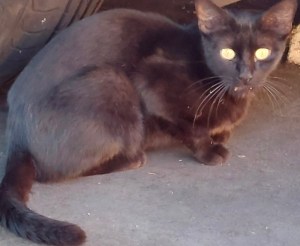
Ha, the cat in the picture certainly looks like an omen of doom! I love the way their eyes look in the full glare of a flash – it shows the evil of their furry little souls… 😉
LikeLike
Hahaha! I think you’re right about cats! In the right light, they do show the evil that lurks inside them, don’t they? And that’s when they look most like omens! No wonder they try to run away whenever people try to take their photos; they don’t want us to know just how deep that evil goes… 😉
LikeLiked by 1 person
Oh, interesting Margot. I don’t know what it is about us humans, but we do often seem to be looking for signs to guide us! The Bennett Sherlock Holmes story is new to me, and I do like the sound of it!
LikeLike
Thanks, KBR! I’m so glad you thought the post was interesting. You’re right, you know, about people. We do seem to look for signs and omens, don’t we? I’m not sure why, but it’s true. As for the Bennett, it’s a very interesting Holmes follow-on. In fact, my next edition of In The Spotlight will feature that book, in case you’re interested in knowing more about it!
LikeLiked by 1 person
Thanks Margot – will look forward to it!
LikeLike
🙂
LikeLike