 Some fictional characters become so beloved that, even after their creators have passed away, others write new mysteries featuring those characters. These follow-on stories can be interesting, and they certainly add to the characters’ stories. That said, though, there are plenty of people who don’t care for follow-ons and believe the characters should be allowed their rest.
There’ve been several follow-ons to Arthur Conan Doyle’s Sherlock Holmes stories, and that’s not surprising, considering what a popular character he’s been for nearly 140 years. I’ll only mention one here, but I’m sure you’ll be able to think of others. In S.F. Bennett’s Sherlock Holmes: The Addleston Tragedy, Holmes and Watson get a visit from Holmes’ cousin, Peregrine Holmes. Peregrine is an antiquarian and amateur historian whose work has come to the attention of renowned professor Horace Mountjoy. In fact, Mountjoy invited Peregrine to visit his barrow excavation near the small town of Addleston. Almost immediately, though, eerie things began to happen. Then, Mountjoy was found killed. Peregrine wants his cousin and Dr. Watson to travel to Addleston to investigate. What they find is hostile local residents, strange occurrences, and real danger. Some people think it’s all got a supernatural explanation, but Holmes doesn’t believe it, and he and Watson work to find out the truth.
Another beloved fictional character is Agatha Christie’s Hercule Poirot. Christie herself didn’t envision Poirot living after her death, so she wrote Curtain to forestall that possibility. However, matters haven’t stayed that way. Poirot is too popular to stay quiet for long. The Christie estate sanctioned Sophie Hannah to write some follow-on novels, beginning with The Monogram Murders. In that novel, Poirot and Inspector Catchpool solve the murders of a group of people who were found dead in their hotel rooms, with a monogrammed cufflink in their mouths. That clue, plus a cryptic note, are all that Poirot and Catchpool have to go on at first, so it’s a complex case. In the end, though, Poirot finds out the truth. These novels have gotten very mixed reviews; most people seem to either very much like them…or not.
Jill Paton Walsh has written several follow-ons to Dorothy L. Sayers’ Lord Peter Wimsey novels. He and Harriet Vane are beloved by millions of crime fiction fans, so it’s not a surprise that they’d be continued by another author. A well-known and talented author of her own works, Walsh based her Lord Peter Wimsey stories on unfinished manuscripts, notes, and other information from Sayers’ files, so the stories are more than just inspired by Sayers’ work. Walsh’s own style isn’t the same as Sayers’ was, so some of the responses to her follow-on stories have been mixed. Still, her work has generally been praised, and it does keep to Sayers’ conception of tone, atmosphere, and character development.
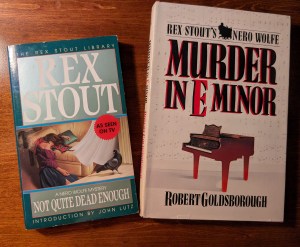
Rex Stout’s Nero Wolfe stories also become extremely popular, leading to several film and television adaptations. There are Nero Wolfe societies, too, and the fictional character has become one of the mainstays of the crime-fictional world. So, it shouldn’t be surprising that, after Stout’s death, there would be several follow-on stories. Perhaps the best-known follow-ons are the work of Robert Goldsborough, who was authorized by the Stout estate to continue the series. One of his novels is Murder in E Minor. In it, we meet Milan Stevens, well-known conductor of the New York Symphony. He’s been getting death threats, and he asks Wolfe to find out who’s responsible. At first, it doesn’t seem that Wolfe will take the case, but he does. Not long after the investigation begins, Stevens is stabbed. Now, Wolfe and Archie Goodwin have to consider a group of suspects, since there was more than one motive for Stevens’ murder. There are now eighteen Nero Wolfe books by Goldsborough, and they’ve had a generally positive reception.
Tony Hillerman created the Joe Leaphorn/Jim Chee novels that take place in the American Southwest, mostly on and near the Navajo Reservation. Fans of this series will know that both men are members of the Navajo Nation and the Navajo Tribal (now Nation) Police. The books became very popular, and Hillerman won international acclaim for his work. Five years after his 2008 death, his daughter Anne continued the Chee and Leaphorn stories that also include Chee’s wife, Bernadette ‘Bernie’ Manuelito. Beginning with Spider Woman’s Daughter, the Anne Hillerman follow-on series now includes ten books. It’s had positive reception on several points (e.g. portrayal of the land and people and respect for the indigenous culture). On the other hand, some Tony Hillerman fans are not as pleased with some of the pacing in her stories. Still, her series has been, overall, well received.
The question of follow-ons is complicated. Some argue that it makes sense to continue beloved characters. And, let’s be honest, it can be financially beneficial. Others, though, say that once the original authors have gone, it’s time for their characters to do so, too. Besides, each author has a unique style and insight, and follow-ons won’t capture that. It’s not a settled issue. What do you think? Do you read follow-ons? What do you think of them?
*NOTE: The title of this post is the title of a song by the Eagles.
 Crime Writer Margot Kinberg
I have to admit I haven’t been fully satisfied by any of the follow-ons I’ve read. Maybe something like taking a real-life historical person or a fictional character from another type of novel and turning them into detectives just works better for me.
LikeLike
You’re not alone, Marina Sofia. There are plenty of people who like beloved fictional characters just as the original author wrote them. You have a point about a real-life historical person, though. I’ve read some novels with such protagonists and they can work. It’s an interesting difference, isn’t it?
LikeLiked by 1 person
I haven’t read many follow-ons or prequels, but I haven’t found them successful. They haven’t worked for me.
LikeLike
You’re not alone, Margaret. Plenty of readers of, say, Sherlock Holmes, Hercule Poirot, or Jim Chee prefer the stories that were written by their original creators. For many readers there’s something to those stories that follow-ons just don’t match.
LikeLike
So interesting, Margot. I totally understand the wish to have further adventures of a favourite character, but for me they rarely work. I’ve tried Christie follow-ons and Sayers ones, and they didn’t gel for me. Most of the Sherlock Holmes sequels haven’t hit the mark either in my view, apart from one – I absolutely loved “The Italian Secretary” by Caleb Carr, which really caught Holmes for me.
LikeLike
I’m glad you enjoyed the Carr, KBR. I confess I’ve not read that one, but I do really like the Holmes stories, so perhaps I should! I think a lot of people feel the way you do about follow-ons in general. It is nice to have a beloved character ‘star’ in a story, and it’s hard to let one go, so to speak. But follow-ons are different to the originals, and for plenty of people, they don’t always quite hit the mark.
LikeLiked by 1 person
I wrote a Sherlock Holmes story some years ago – it was a lot of fun. I think – I hope – I pulled it off! It did get published.
>
LikeLike
I didn’t know that, Christine! I can well imagine it was fun! Knowing you, I am sure you pulled it off and not surprised it got published.
LikeLike
Margot: I read a couple of Goldsborough books featuring Wolfe long enough ago I cannot remember how far back. I liked them though not enough to keep reading the series. Maybe it is time for another look.
There are so many Holmesian books I think it was inevitable some of them were very good. I have read some of them. There were also Holmesian books I wish I had not picked up.
What your interesting post caused me to reflect was that all of your examples were either British or American sleuths. I have thought of the different Canadian series I have read and I cannot recall a single continuation after the author’s death. Casting my mind around the world I cannot think of a series continued after the author died. I speculate that the reason is that English and American authors have the largest readership for their books. I would be interested in your thoughts especially if you can recall world authors being continued.
LikeLike
I’ve liked the Goldsborough work I’ve read, too, Bill, but I haven’t sought more of them out. And you’re right, I think, about Holmes follow-ons. There really have been so many that you can’t really make a blanket statement about their quality. Like you, I’ve read well-written ones and ones that weren’t. But then, I’m a hard sell when it comes to follow-ons.
You ask a really interesting question about follow-ons of authors who are neither US nor British. I don’t think I’ve ever read one, and on first thought, none come to my mind. Of course, it’s a big world with plenty of authors I’ve not read, so I’ll keep thinking about it. If you’re right, it certainly could be that there’s more readership among English and US audiences. That would make sense. Hmm..this is an excellent question, and I’ll keep thinking about it.
LikeLike
I had a discussion about follow-ons the other day, and for the most part, I’m not a fan. I think the reason is that the heart isn’t there. What made the original writer so good and readable was heart. Just my opinion. 🙂
LikeLike
That’s really interesting, Cat! Each beloved fictional character is the brainchild of a creator with heart. Can you separate that from the character? Some people can do it well, but a lot can’t. Perhaps that is what’s missing…
LikeLiked by 1 person
I suspect that it is heart that’s missing. It would very hard to copy another writers style to continue a series especially when it comes to series characters.
LikeLike
That’s quite true, Cat. There’s just something about that individual writer, and heart is a good way to describe it, that makes it hard to emulate, let alone copy.
LikeLike
In general, I don’t care for new authors picking up a series and continuing with it. But really the only one I have tried is Robert Goldsborough’s continuation of the Nero Wolfe series. Goldsborough wrote 7 additional books between 1986 and 1993. I read all of those. They were not as good as the original series, but I found them entertaining (and convincing) enough to read them. And I still have my copies of those.
Later in 2012, Goldsborough wrote more of continuation series, 11 additional books to date. I read the 2012 book but I have not continued since then. Maybe those were placed too much in the present to suit me. Although that is the way the entire original series was handled. Archie and Wolfe stayed the same age but time moved on and current attitudes and new technology were included.
LikeLike
Thanks, Tracy, for your thoughts on continuations and follow-ons. I have to admit I agree that Goldsborough’s Nero Wolfe stories aren’t as good as the original. They’re entertaining, as you say, but not as well done as the Rex Stout books. I have to admit, I’ve not read the more recent continuation books. It’s interesting, isn’t it, how the time a series is set can impact whether we like it. I’m not surprised that you noticed that difference.
LikeLike
I personally don’t have a major objection to beloved characters going on after the author’s death, but I can also appreciate the purists’ views. I will stay say that the original author has yet to be surpassed by the pastiche authors.
LikeLike
There are plenty of people who agree with you, Peter, that the original authors write those beloved characters the best. After all, they are those authors’ creations. Some of the pastiches can be done well, and they have welcoming audiences. But there’s something about that connection between the character and the original author.
LikeLike