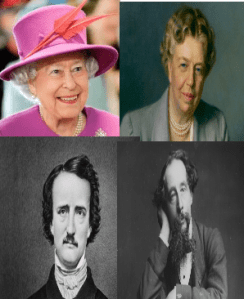
 A recent interesting post from Bill Selnes at Mysteries and More From Saskatchewan has got me thinking about novels and series where the sleuth is an actual historical figure. Bill’s fine post, which I strongly encourage you to read, is a review of S.J. Bennett’s The Windsor Knot. In Bennett’s series (of which The Windsor Knot is the first), Queen Elizabeth II is the protagonist and sleuth. The Windsor Knot takes place in 2016, when the Queen is 90. The other books, though, take place at different times in the Queen’s life, which gives Bennett flexibility. Different places, different palace staff, and so on all add variety to the novels. And the Queen’s access to all sorts of ‘seats of power’ makes for a lot of possibility when it comes to plots.
You might say a similar thing about Eleanor Roosevelt, the protagonist in her son Elliott Roosevelt’s mystery series. Beginning with Murder and the First Lady, the series consists of twenty books, with the first nineteen written by Elliott Roosevelt, and the last written by William Harrington. As you’ll know, Eleanor Roosevelt was influential in many spheres, not just in her duties as First Lady. This allows for plenty of different settings, characters, and more. And, like Queen Elizabeth II, Eleanor Roosevelt was smart, observant, and able to move in different circles, including exalted ones. That makes her a solid protagonist for the story.
Canada’s Fireside Publishing House released the Leaders and Legacies mystery series. The novels feature Canada’s prime ministers as teens, and each story focuses on a different one. For example, Showdown at Border Town, written by Caroline Woodward, features former Prime Minister Paul Martin. In the book, twelve-year-old Paul Martin and his friend Abby befriend a new arrival, Tom Whitehawk, who’s just arrived from the reservation. Tom gets a job on a fishing boat owned by Bob Brunner, and it’s not long before the young people notice some odd things going on with Brunner. They’re soon drawn into web of real danger as they work out what’s really happening. It’s worth noting that at the time Woodward wrote this book, she was fifteen.
Louis Bayard has written several standalones, a few of which include real historical figures as sleuths. For instance, The Pale Blue Eye takes place in 1830 at West Point. One of the cadets is found hanged in apparent case of suicide. But the next morning, it’s discovered that the body’s heart is missing. Former police detective Augustus Landor is asked to investigate, so the academy doesn’t get the bad press that goes with a murder investigation. One of the other cadets, a young Edgar Allan Poe, wants to help in the investigation, and he works with Landor to find out the truth. Among other things, it’s an interesting speculation on Poe’s life before he turned his focus to writing.
There’s also Heather Redmond’s Dickens of a Crime series. These novels feature a young Charles Dickens and his fiancée, later wife, Kate Hogarth, as amateur sleuths. The novels take place in Victorian London, and that city plays an important part in the stories. For instance, in the first novel, A Tale of Two Murders, Dickens is at a dinner party when a scream alerts the guests to danger in the house next door. They rush over to that house to find Christiana Lugoson unconscious on the floor. By the next morning, she’s dead. When Dickens hears about a similar murder that took place a year earlier, he begins to suspect that the two deaths might be related. And so they turn out to be. You’ll notice the play on words in the title; the other titles also give the nod to Dickens’ books: Grave Expectations, A Christmas Carol Murder, The Pickwick Murders, A Twist of Murder. Interestingly, Redmond has also written a series featuring Mary Shelley as an amateur sleuth.
It’s a bit tricky to write a novel that features a real historical figure. The protagonist has to be believable as a sleuth, and there has to be enough historical context to provide setting, background, and so on. The mysteries have to be consistent with the protagonist, too, and that entails a solid knowledge of the real person’s life. Still, when it’s done carefully, this sort of novel can offer interesting perspective on a real person’s life at the same time as it’s offering a solid story. Do you read or write mysteries with a real-life historical figure as protagonist? What do you think of the idea? Thanks, Bill for the inspiration. Now, treat yourself to a visit to Bill’s blog, where you’ll find thoughtful reviews, commentary, and more.
*NOTE: The title of this post is the title of a song by the Who.
 Crime Writer Margot Kinberg
I really like Nicola Upson’s series featuring real-life author Josephine Tey (and Alfred Hitchcock in a side role and others).
LikeLike
That is a good series, Marina Sofia. Thank you for mentioning it. Upson does a good job, doesn’t she?
LikeLike
I’ve read and enjoyed several of Stephanie Barron’s Being a Jane Austen Mystery books that features Jane Austen as a sleuth. The stories are fun.
LikeLike
I’m glad you mentioned Barron’s book, RRN. That’s a really good example of what I had in mind with this post. And it’s interesting to think of someone with Austen’s perceptiveness as an amateur sleuth, isn’t it?
LikeLiked by 1 person
Margot: Thanks for the kind words and mention of the blog. Trust you to come up with a number of other “historic figure” sleuths.
I have read and enjoyed Caroline Woodward’s mystery featuring the young Paul Martin. It adds an intriguing element to the story to imagine the historic figure as a youth and connect the 12 year old of the book with the PM as an adult.
Only after I read books in S.J. Bennett’s the Queen Investigates series did I realize Queen Elizabeth was a very logical choice for a sleuth. Her intelligence, determination, innate curiosity and extensive resources make her a credible sleuth.
LikeLike
It’s a pleasure to mention both your fine blog and the post, Bill. It really got me thinking, which I always appreciate. I think it really is interesting to imagine the various PMs as young people. As you say, it adds an intriguing element to understanding their lives, and I think it makes them seem more human. That connection lends an extra dimension to their stories. And yes, Queen Elizabeth would have been a very believable sleuth. She had all of the qualities and the social position to find out and make sense of all sorts of things. Bennett made, I think, a good choice of her as the protagonist of that series.
LikeLike
Interesting post, Margot, and I agree that this can be a hard thing to do. The Upson/Tey books didn’t quite gel for me, though I know others love them. I did enjoy Gyles Brandreth’s Oscar Wilde mysteries, though, and I suspect that may come from the real affection he had for his subject and the depth of his knowledge about Wilde. But a tricky road to go down, I feel…
LikeLike
It is tricky, isn’t it, KBR? Sometimes it works well, and sometimes not so well, and of course, it’s not for everyone. I think you put your finger on something important, actually: the relationship between the author and the subject. If there is deep knowledge and real affection, that adds a great deal to the quality of a series like this. But it’s not easy. Thanks for the kind words!
LikeLiked by 1 person
I’ve noticed more “real people” showing up lately in mysteries and other fiction. For example, I like the Cozy American in Paris series by Colleen Cambridge, which features Julia Child.
LikeLike
There are a number of such series out, aren’t there, Becky? And that’s a good example of one. I admit I’ve not read Cambridge’s work, but I hear good things about it.
LikeLiked by 1 person
In this series, she does a great job with the setting and time period.
LikeLike
That’s good to know, Becky.
LikeLiked by 1 person
I’m not an enthusiast for books that use real people in this way. I get a bit bogged down in the actual history of the person and that leads to credibility problems. On the whole I prefer fictional characters to be exactly that – fictional. Having real people appear as extras in the background works better for me than having them as protagonists.
LikeLike
You’re not alone, FictionFan. It takes a finesse that not all authors have to make a real historical character work as a protagonist like that. As you say, it leads to credibility issues. You make an interesting point about having those same real characters move in and out of stories as background characters. That can work well for people if it’s done effectively. It can even lend a certain sense of place and time.
LikeLike