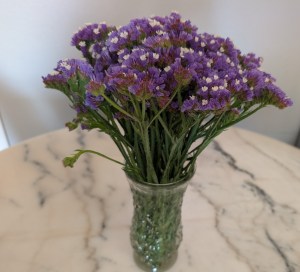
 Aren’t these flowers lovely? I got them as a gift from my neighbor (Sorry, Commonwealth friends. I’ve been looking all over for an extra supply of the letter u and can’t find any anywhere. I hope I may be forgiven…). If you’ve ever had neighbor who looked after your pet, watered your plants, brought you a cake or watched your children, you know how valuable a kind neighbor can be. It got me thinking about crime-fictional neighbors, and there are all sorts of examples.
Agatha Christie’s The Murder of Roger Ackroyd begins as Hercule Poirot settles into the village of Kings Abbot, where he’s planned to retire. His new neighbors are Dr. James Sheppard and his sister Caroline. At first, the Sheppards don’t know much about Poirot, but one day, Poirot loses his temper at one of his vegetable marrows and throws it, accidentally almost hitting Sheppard. After profuse apologies, Poirot and Sheppard chat a bit, as neighbors sometimes do, and Caroline becomes intensely curious about Poirot. Then, wealthy magnate Roger Ackroyd is murdered. Since Sheppard is a doctor, and was Ackroyd’s friend, it’s not long before Poirot is drawn into the murder. Throughout the novel, it’s interesting to see how Poirot and Sheppard interact, both as neighbors and as people involved in the investigation. And it’s very interesting to get the Sheppards’ perspective on Poirot.
Anthony Bidulka’s Russell Quant is a Saskatoon-based PI, which means he sometimes travels and he certainly has a busy life. That can make it hard for him to do things like taking care of his schnauzer Barbra. Fortunately, his neighbors Kelly and Errall own Barbra’s brother Brutus. They’re always happy to look after Barbra when Russell is away, and of course, he looks after Brutus, too, when it’s needed. He also has an enigmatic but very helpful neighbor called Sereena Orion Smith. She has a way of dropping in just when Russell needs her help. It makes for a solid bond between Russell and his neighbors, and they’ve gotten him out of more than one difficult situation.
In Judy K. Walker’s Back to Lazarus, we are introduced to Sydney Brennan. She’s a Tallahassee-based investigator who does freelance work for various attorneys’ offices. Her neighbor Ben is a sixteen-year-old high school student who takes care of Sydney’s home, feeds her fish, and so on when she’s out of town. She’s come to depend on Ben, and he, in turn, sees her as a trusted person he can talk to when he doesn’t want to talk to his family. The two of them have a solid relationship, and in Back to Lazarus, Ben proves to be especially helpful when Sydney is attacked in the course of one of her investigations.
Kerry Greenwood’s Corinna Chapman is a former accountant-turned-baker who lives and has her bakery in a Roman-style Melbourne building called Insula. She’s got several neighbors: a Wiccan who owns her own shop; two young girls dreaming of becoming soap opera stars; a professor; a group of gamers who repair computers; and a few others. They’ve formed a sold community with each other and are ready to help when needed. For example, the gamers have a company called Nerds Inc. When Corinna needs help with a balky computer, she turns to them. In exchange, she uses her financial skills to help them with business glitches. Favors among the neighbors are freely asked and freely granted.
Karim Miské’s Arab Jazz introduces readers to Parisian resident Ahmed Taroudant. He’s often been helpful to his neighbor, Laura Vignola, who lives in the apartment above his. He waters her plants, and he has an extra key to her apartment in case of emergency. One day, he looks up from his own balcony and sees that she is dead. He rushes to her home and then calls the police. Almost immediately, he becomes a person of interest. For one thing, he had easy access to the victim. For another, he had a sort of relationship with her, although it wasn’t really an ‘official’ romance. So, as you can imagine, he wants to find out who killed Laura, not only to clear his own name, but also to make up for the time they won’t have together. It turns out to be a complicated case, and it’s interesting that the real protagonist in this murder mystery is a neighbor.
And that’s the thing about good neighbors. It can give one a real feeling of safety to know that a neighbor has a spare key, or can help fix or move something, or can watch the children for a bit, or can run an errand. Those bonds can mean a lot, and it can add to a crime novel to have such characters. Of course, as any crime fiction fan can tell you, neighbors are not always what they seem to be. I can’t really discuss particular novels – no spoilers here – but if you read enough crime fiction, you know that a cheerful and helpful neighbor can hide any number of secrets…
*NOTE: The title of this post is the title of a song by the Rembrandts.


I’ve got an extra u, so will use it to say how much I enjoy your sense of humour, Margot!
LikeLike
Why, thank you, RRN! Much appreciated! 😀
LikeLiked by 1 person
Yay for a mention of Arab Jazz, which does such a good job of describing the neighboUrhood! 😉 in my new home I don’t necessarily know the neighbours on my floor other than taking parcels in for them but I do know people who live on my street.
LikeLike
Wasn’t Arab Jazz fantastic, Marina Sofia? And you’re right, there’s such a good description of where Laura lives, isn’t there? I know what you mean, too, about people you sort of know at the taking-in-parcels level, and people you know a bit better. I know some people where I live, and others are just the say-good-morning-to sort of people.
LikeLike
Neighbours are great characters in crime fiction, and I would say they’re a mainstay in certain types of GA mysteries. I mean, what small village which is riddled with murders would get by without neighbours gossiping or lending a hand or having conflicts? St. Mary Mead is just one example…. 😉
LikeLike
You make a very good point, KBR. There’s something about the village with secrets and murders that just thrives on ‘the people who live next door’ or ‘the lady down the street,’ or…. That’s where you have the old secrets, the conflicts, the juicy gossip, the whole thing. ANs St. Mary Mead is great example! 🙂
LikeLiked by 1 person
We’re shipping an emergency supply of ‘u’s over immediately – look out for an approaching U-boat! Off the top of my head I can only think of examples of your second type of neighbours – the ones who turn out to be not quite as nice as they seem!
LikeLike
Hahahahaha! Thank you, FictionFan! I’m getting desperate here, and a U-boat is just what’s needed (very clever!)! You’re right, too, that there are plenty of crime novels where the seemingly lovely people next door or across the street or wherever are not what they seem to be…
LikeLiked by 1 person
Well done Margot. You set me thinking. I just wrote a post on Anthony Bidulka’s new book Quant about growing up on the farm in Saskatchewan. Neighbours are very important in the country. While I love Anthony’s neighbours in the Russell Quant series my mind went to Three Pines in the Armand Gamache books of Louise Penny. Armand, Reine Marie, Clara, Ruth, Myrna, Gabri and Olivier feel like real life neighbours over the series. They share food. They care for each other. They physically visit constantly. I have said more than once I wish Three Pines was a real place I could visit.
LikeLike
Thanks, Bill. I’m glad you thought the post worked. I’m very much enjoying Quant myself, and yes, neighbors are extremely important when you live in the country. They form real bonds. I think you’re right about the people of Three Pines, too. They really share each other’s lives, and they do look after each other. I’d love to visit Three Pines, too, if it were a real place. Oh, well, it becomes real as you open one of the books and read…
LikeLike