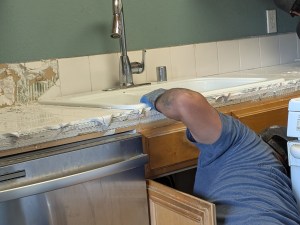
 One of the things about home ownership (or even apartment living, for the matter of that), is that things sometimes need to be repaired. Appliances fail, plumbing needs to be fixed, the heating or air conditioning breaks, or something else happens. It’s annoying at best and can sometimes be maddening. In fiction, though, the need for repairs offers lots of possibilities for plot points and characters. There are even crime-fictional protagonists, such as Phoebe Atwood Taylor’s Asey Mayo, who do repairs. Here are a few other plumbers and other workers who show up in crime fiction.
In Arthur Conan Doyle’s The Adventure of Charles Augustus Milverton, Sherlock Holmes takes the case of Lady Eva Blackwell. She’s to be married soon, and Milverton has been blackmailing her over some compromising letters she wrote to someone else years earlier. Holmes does speak with Milverton, but he very quickly learns that Milverton will not stop or return the letters. So, he will have to come up with another plan. He disguises himself as a workman and approaches the members of Milverton’s house staff, including one maid in particular. He cultivates a friendship with her as he pretends to do work around the place, and she tells him information he needs. It’s not exactly an upfront approach to solving the case, but it serves Holmes’ purpose.
Agatha Christie’s Postern of Fate is the last of her Tommy and Tuppence Beresford novels. In it, the Beresfords have just moved to a new home and are settling in. In one plot line of the novel, the house needs repairs, and the Beresfords have hired workers to do the jobs. Unfortunately, they come and go at inconvenient times and leave dust, debris, and holes in the floor in their wake. In the meantime, the Beresfords are on the trail of a long-ago murder that’s tied to international espionage, so they don’t have the time or patience to deal with unreliable workers. It’s the cause for a lot of nuisance for them.
In Michael Robotham’s The Suspect, we are introduced to London psychologist Joe O’Laughlin. He is drawn into a case of multiple murders when the body of a young woman called Catherine McBride is pulled from a canal. As it turns out, she’s a former client of O’Loughlin’s so he reluctantly agrees to help work out who would have wanted to kill her. Then, there’s another murder, and this one implicates O’Loughlin. Detective Inspector (DI) Vincent Ruiz doesn’t want to think O’Loughlin’s guilty, and O’Loughlin himself says he’s innocent. But Ruiz has to do his job. O’Loughlin will have to work fast to find out who the killer is if he doesn’t want to end up on trial himself. To add to O’Laughlin’s worries, the boiler in his home has stopped working, so he has to call a plumber in. It’s a more complicated job than it seems on the surface, so there’s no rest for O’Laughlin even at home.
Linwood Barclay’s Bad Move is the story of science fiction novelist Zack Walker and his family. Walker moves his family from the city to a new suburban development called Valley Forest Estates. His thinking is that life there will be easier and safer, and a nice home will be more affordable. Things don’t turn out as planned, though. For one thing, the home wasn’t solidly built, so it needs repairs. Walker hasn’t had any success calling the sales office about the matter, so he goes there in person to complain and to demand that repair people be sent to fix the home. While there, he witnesses an argument between one of Valley Forest’s sales executives and Samuel Spender, a local eco-activist. When he gets his chance, Walker makes his complaint and is promised the needed repairs. He leaves, only to later find Spender’s body. Now, he’s drawn into a case of murder that leads to all sorts of other complications. In the meantime, repair people come to his home, and that, too, has a lot of difficult complications.
And then there’s Nicci French’s Blue Monday, the first of her series featuring London psychologist Frieda Klein. The main plot concerns the connection between the long-ago abduction of a young girl and the more recent disappearance of a four-year-old boy. Frieda has read about the young boy’s abduction and begins to wonder wither it might have something to do with things she’s learned about one of her clients, Alan Dekkar. She has several sessions with Dekkar, including one in which they are interrupted. They are having an intense conversation when the ceiling above them breaks and a man falls through. He is Ukrainian builder Joseph Morozov, who’s been making repairs to the rooms above. Everyone tries to make the best of the situation, but it certainly changes the atmosphere. Here’s what Frieda and her client say about it:
‘Does it look serious,’ said Frieda.
Alan pulled a face. ‘Lucky I’m not at work.’
‘Are you a builder?’
‘I work for the housing department,’ he said. ‘I’d have something to say about that if I was at work.’’
Morozov repairs the ceiling as quickly as he can, and he proves to be a interesting character who’s helpful in the story.
It’s always at least annoying when you have to call in someone to make repairs. But it’s sometimes necessary. And after all, plumbing, electrical work, construction and so on provide millions of jobs. And such people can make for interesting characters, and their stories can add to a crime novel.
*NOTE: The title of this post is the title of a song by Jimmy Jones and Otis Blackwell.


A very interesting angle, Margot. Posting as some kind of workperson could definitely get you access to a house, which would be a godsend for some sorts of criminal. I guess we need to check really closely who we’re letting into our home…
LikeLiked by 1 person
Thanks, KBE. And you have a very well-taken point. A lot of people don’t think twice about letting workmen, cable installers, etc. in. I wonder how often we check their legitimacy. It’s certainly fodder for a good crime story!
LikeLiked by 1 person
Could be dangerous indeed… that’s why I hated to get things done in my old house, and developed a very close relationship (not that kind!) to a particular trustworthy handyman. And this past week or two my coffee machine was broken, so I was in agony until this morning, when I finally was able to get a spare part installed.
LikeLiked by 1 person
Your coffee machine was broken, Marina Sofia!? Oh, that is terrible! I’m glad you were able to get it fixed. And I know what you mean about depending on a trustworthy handyman; they’re worth their weight in gold. And working with a handyman is often less costly than going with a large company, and it does feel safer to go with someone you trust. As you say, letting just anyone into your home can be dangerous…
LikeLike
There used to be a guy who did all kinds of repairs for everyone around here and that was great, because we all knew him and new he was honest and reliable – and not a murderer! But he’s moved elsewhere now and we’re back to picking random names out of the phonebook – chancier than playing roulette! Sometimes I think it would be easier just to let the house fall apart… 😉
LikeLike
Oh, bad luck your dependable handyman would leave, FictionFan! A good, trustworthy one is priceless, and I can only imagine how annoying that must have been. Around here, there are websites you can go to and Facebook groups to find someone reliable, but it’s always a crap shoot. It sometimes makes letting a place go sound very appealing, doesn’t it? 😉
LikeLiked by 1 person
That interesting post caused me a couple of days of reflection Margot. In my memory I could not recall a handyman from legal mysteries. There should have been lots. Many lawyers like myself are distinctly unhandy. Unless the ink is running few lawyers get their hands dirty. How handy are university professors?
LikeLiked by 1 person
Thanks, Bill. I’m glad you found the post interesting. And, as I think about it, I can’t recall a legal novel, either, that has a handyman in it. And you know, I don’t know any lawyers who are really good at DIY, either. That does seem odd. The same thing goes for professors, I think. Beyond basic things (like putting together an Ikea kit), I don’t know a lot of professors who are handy. And it’s funny; I also don’t know of a lot of handymen in crime novels featuring professors.
LikeLike