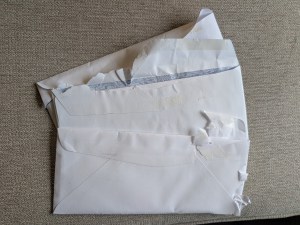
 In the novel I’m currently revising (it’s a new Patricia Stanley novel), one of the characters died a hundred years before the novel takes place. So, the present-day characters can only get to know that person through her letters. Those letters prove to be crucial in solving a modern murder. If you think about it, learning about a person through letters makes sense. Especially in the time before the telephone and modern electronic communication, letters were an important way to find out about a person. It’s no wonder, then, that we see them throughout crime fiction.
In Agatha Christie’s Five Little Pigs, for instance, Carla Lemarchant hires Hercule Poirot to find out the truth behind the sixteen-year-old murder of her father, famous painter Amyas Crale. At the time, her mother, Caroline, was accused of the crime, and she had motive. Her husband was carrying on a not-well-hidden affair with another woman. Caroline was arrested, tried, and convicted in connection with the crime, and died in prison a year later. Carla is convinced that her mother was innocent and wants Poirot to discover what really happened. Poirot meets with each of the five people who were on the scene at the time of the murder. He also arranges for each to send him a letter detailing what happened. Those letters reveal quite a lot about the characters who wrote them. And one character, Caroline’s half-sister, Angela, has a letter from Caroline that reveals important things about her personalityt, too. It’s an interesting way for Poirot to learn what happened.
Val McDermid’s The Grave Tattoo introduces Wordsworth scholar Jane Gresham. She’s hoping for a successful academic career, but so far, she’s still new at it and hasn’t made her mark on the world yet. Then, she hears that a body has been pulled from a bog not far from her hometown in the Lake District. There’s a possibility that it may be the body of Fletcher Christian. If it is, then he didn’t die on Pitcairn Island. And if that’s the case, then he could have met with his great friend Wordsworth, and nothing would be more natural than that he’d tell his story. That would mean there’s an unpublished Wordsworth manuscript somewhere and finding it would guarantee Jane’s career. So, she travels to the Lake District to find out the truth. What she finds, though, is much more danger than she’d thought. As she searches for the truth, someone is dogging her footsteps and leaving murder in the wake. Woven throughout the novel are old letters that give insight into what really happened. And they play an important role in the story.
Graeme Macrae Burnet’s His Bloody Project features young Roderick Macrae, who lives with his family in the small Scottish village of Culduie, on Scotland’s Applecross Peninsula. It’s1869, and Roderick has run afoul of Lachlan Mackenzie/Broad, the local constable. Because of that, Mackenzie/Broad makes the Macrae family’s life as miserable as possible. To make matters worse, the constable works for the wealthy and powerful Middleton family, so the Macraes don’t have much recourse. Then, three murders are committed, and in no time, Roderick Macrae is arrested and jailed for them. He doesn’t have much of a chance at his upcoming trial; in fact, he’s never denied being the killer. The only question is, was he insane at the time, or did he plan the murders? His lawyer suggests he write what happened. So, as a last-ditch effort, Roderick writes of his life, his family, the oppression, and what led to the murders. Through that writing, we learn a great deal about Roderick.
Paddy Richardson’s Traces of Red introduces Wellington telejournalist Rebecca Thorne. She knows how competitive the world of journalism is, and she hopes for that one story that will cement her position at the top of New Zealand TV journalism. She thinks she’s found that story in the case of Connor Bligh. He’s been in prison for years for the murder of his sister, Angela Dickson, her husband Rowan, and their son, Sam. Only their daughter, Katy, survived, because she wasn’t home at the time of the murders. While just about everyone thinks Connor’s guilty, there are hints that he may be innocent. So, despite advice to leave the story alone, Rebecca decides to follow up. She meets with Connor Bligh, and he then sends her a long letter in which he details his life. As the letter goes on, we learn about his history and about the crime, from his point of view, and it’s a fascinating insight into his character.
In Caroline Overington’s Sisters of Mercy, we meet New South Wales journalist Jack ‘Tap’ Fawcett. He doesn’t usually cover missing person stories, but this new one is unusual. It seems that Agnes Moore, who was visiting from England, went missing during a heavy sandstorm. Her daughter, Ruby, has come to Australia to find her mother, and Fawcett writes up the story. Then, he begins to get letters from another woman, Agnes’ sister Sally Narelle ‘Snow’ Delaney. She’s in prison for a crime that’s revealed as the story goes on. She’s been following Fawcett’s stories, and she is convinced he has several details wrong. So, she’s decided to write and point out his mistakes. Thus begins a correspondence between the two. In the letters, Snow tells of her life, Agnes’ life, and what’s happened to her through the years. We learn a great deal about her character as well as the crime that landed her in prison. It’s an interesting approach to character development.
Letters can reveal a lot about the writer. So it’s no wonder that they’re used in fiction for character development and background information. Sometimes they contain important clues, too…
*NOTE: The title of this post is a line from Jack Tempchin and Robb Strandlund’s Already Gone, made famous by the Eagles.


You can do so much with letters in a mystery plot, can’t you? Lost letters, hidden ones, letters which turn up a long time after they were sent. They make wonderful plot points! And you have one of my favourite Christies in there – I really should revisit it!
LikeLike
That’s a great thing about letters when it comes to crime fiction plots, KBR. There’s so much you can do with that plot point. And it can all build suspense and tension. It’s little wonder we see them so often in the genre! And I agree with you about Five Little Pigs. It’s a wonderful Christie novel, isn’t it?
LikeLiked by 1 person
The passing of letters is going to leave a big hole in fiction in the future – emails just don’t have the same impact! In Robert Goddard’s Past Caring, the protagonist is looking into the sudden resignation of a cabinet minister in the time of the Suffragettes, and is using old journals and letters as part of his research. But it appears that even now – the 1980s – some people don’t want the truth of what happened back then to come out…
LikeLike
You definitely have a point, FictionFan. There’s just something about a letter that carries an impact. Emails, texts, and so onhave their important uses, but they don’t have that ‘wallop,’ do they? Thanks very much for mentioning Past Caring. Robert Goddard did a really fine job, in my opinion, of blending a solid mystery plot with with and subtle commentary. I’m glad you mentioned that one. Folks, you’ll want to read FictionFan’s excellent review of Past Caring. You’ll be glad you did!
LikeLiked by 1 person
Thanks for the link and the kind words, Margot! 😀
LikeLike
A pleasure as ever, FictionFan! 😃
LikeLiked by 1 person
Thanks for writing about letters. I love letters. I think they are a wonderful form of communication. I have evolved to thinking letters can remain letters if formatted as letters even if sent by email.
My favourite work of fiction of letters is The Guernsey Literary and Potato Peel Pie Society by Annie Barrows. The exchanges of letters mainly in WW II are so vivid.
I regret to say I write few paper letters anymore. I do cherish when someone writes me a paper letter.
LikeLike
Letters are great aren’t they, Bill? They allow for a kind of communication that you don’t see in texts or short email notes. The show as much about the relationship between two people as they anything else. And, to be honest, I don’t write a lot of paper letters – cards and notecards, yes, but few paper letters. And thanks for mentioning The Guernsey Literary and Potato Peel Pie Society<. It’s a fine story and yes, an excellent example of how letters form relationships and how they convey a place and time. Folks, please do read Bill’s excellent review of The Guernsey Literary and Potato Peel Pie Society.
LikeLike