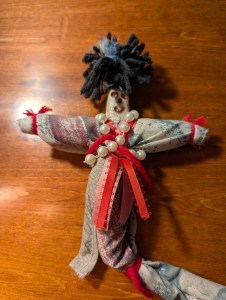
 Throughout history, when something unexplained has happened, especially bad things, people have been quick to call it ‘witchcraft.’ And some have paid a very heavy price for that. In crime fiction, the occult can be used to provide an effective coverup for a very prosaic crime. And that can add a certain eeriness and tension to a story. There are plenty of examples of how this works; here are just a few.
In Agatha Christie’s The Pale Horse, historian Mark Easterbrook is drawn into a strange set of murders when he sees a fight between two young women, after which one of them dies. As a witness, he may be able to give the police useful information. And he wants to know what’s behind that death and others that occur. So he starts asking questions. The murders seem to be related to an old inn called The Pale Horse, where three women who are said to be modern-day witches live. It’s a complicated case, and it shows just how much people’s beliefs in witches, mediums, and so on can influence their perception.
Tony Hillerman’s Skinwalkers begins as Sergeant Jim Chee of the Navajo Tribal (now Nation) Police narrowly avoids being shot in his home. We soon learn that there’ve been other, successful assassination attempts on the Reservation, and Chee works with Lieutenant Joe Leaphorn to find out who’s behind them. The trail leads to the Badwater Clinic, which uses both traditional healing methods and modern healing methods. And one traditional belief is in skinwalkers, sorcerers who use spiritual teachings for their own evil plans. So, as Chee and Lieutenant Joe Leaphorn investigate, they have to find out who might be regarded as a skinwalker.
Elizabeth George’s Missing Joseph is the story of a village vicar, Robin Sage. When Deborah St. James meets him, she is deeply impressed with him, and persuades her husband, Simon, to go with her to visit the vicar in his home village. By the time they get there, though, Sage has been killed. It seems that local herbalist Juliet Spence invited Sage for dinner and accidentally served him a salad made with water hemlock. Of course she’s considered the main suspect in the death, and it doesn’t help matters that many of the locals consider her a witch. But there’s more to this case than that, and Simon asks his friend, Inspector Thomas Lynley, to investigate. Among other things, this is an interesting look at how people’s perception of a character impacts what they say and what they think they remember.
In Julia Keller’s Bitter River, the body of sixteen-year-old Lucinda Trimble is found in a car at the bottom of Bitter River, near Acker’s Gap, West Virginia. It quickly comes out that she was dead before she went into the water, so this becomes a murder investigation. Prosecuting attorney Belfa ‘Bell’ Elkins works with Sheriff Nick Fogelsong to find the killer. One of Bell’s first stops is the home of Lucinda’s mother, Madeline ‘Maddie.’ She lives on the outskirts of town, and is known to be a bit eccentric, so there are people who think she’s a witch. And they’re only too happy to believe she would kill. And she had arguments with her daughter, as parents do. So she’s definitely on Bell’s list of ‘people of interest.’ It’s a more complex case than it seems on the surface, and Bell will have to cut through several layers of lies and dark secrets.
There’s also Kwei Quartey’s Wife of the Gods. In it, Accra Detective Inspector (DI) Darko Dawson is seconded to the town of Ketanu, where the body of Gladys Mensah has been discovered. There are several possible motives for murder, too. For one thing, the victim alienated the chief and High Priest of the village, Togbe Adzima. He is seen as the intermediary between the physical world and the spiritual world. So running afoul of him is a very dangerous thing to do. Matters are complicated by the fact that several men were interested in Gladys. If she rejected one of them, who knows what might happen? Also, she was a volunteer with Ghana’s Ministry of Health, trying to make condoms, AIDS/HIV prevention information, and other important health resources available to people in the village. There are plenty of people who see that effort as immoral and might not stop at killing her. In more than one place in the novel, we see the way people can view those they believe to be witches, occult healers, and so on.
As a rule, we don’t care for the unexplained – we want answers. And for some people, when those unexplained things happen, it’s put down to witchcraft. That can have serious consequences. It can also be an effective way to cover up the truth about a murder.
*NOTE: The title of this post is the title of a song by Jalacy ‘Screamin’ Jay’ Hawkins and Herb Slotkin.


I love The Pale Horse – there are bits of it that are genuinely creepy. Her occasional forays to the spooky side are always fun – she had a real flair for that kind of supernatural horror, or for making things feel like supernatural horror even when they aren’t.
LikeLike
The Pale Horse is a good ‘un, isn’t it? FictionFan? There is definitely something about the way Christie wrote about the spooky side of life. She had a way of weaving the supernatural in (or at least, belief in it) without sacrificing credibility. And she could definitely weave an eerie atmosphere!
LikeLiked by 1 person
An interesting angle, Margot. I think it can work really well when magical elements are used as a blind in a crime novel, and Pale Horse is a great example to pull out. Christie was really skilled at building in spookier aspects which were very convincing in her mysteries!
LikeLike
Thanks, KBR. I agree with you that The Pale Horse shows Christie’s skill at weaving eerie elements to a story. The way she did it, it’s easy to see why a character might believe in the supernatural. And yet, she always had a logical explanation for things!
LikeLiked by 1 person