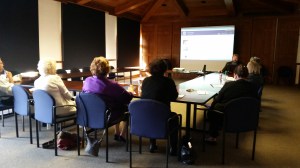
 Unless you’re self-employed (and sometimes, even if you are), you probably experience your share of group meetings. Sometimes those meetings are pleasant and productive. Sometimes…they’re not, In spite of the fact that we’re all familiar with meetings, we don’t always think of them when it comes to the police. But police have group meetings at least as much as any other profession. That’s where everyone is updated on the status of the cases going on, and that’s where new people are introduced and new assignments given. So it’s no wonder that police meetings show up quite frequently in crime fiction.
In Agatha Christie’s The ABC Murders, for instance, Hercule Poirot and Chief Inspector Japp try to solve a puzzling series of murders. Each one is preceded by a cryptic warning note that’s sent to Poirot, and an ABC railway guide is found near each body. Otherwise, the victims have almost nothing in common. Franklin Clarke, brother to one of the victims, approaches Poirot with the idea that relatives of each victim should get together and see if there are any commonalities that they can find. Poirot agrees, and the group meets. It’s an interesting idea and some solid points are made. Poirot also finds that he learns some important information once the group begins to get together.
In Karin Slaughter’s Cop Town, we are introduced to new police recruit Kate Murphy. The place is Atlanta and the time is the 1970s, so women on the police force have very few options and little say in their careers. Most of their male colleagues don’t even think they should be there, and they can be cruel. Nevertheless, Kate and Maggie Lawson, who also works for the police, form a friendship and hope they can carve out places for themselves. But they soon learn that they’re expected to be quiet at meetings, tolerate their male colleagues’ inappropriate remarks, and put up with whatever’s going on. Atthe regular pre-shift meetings, Kate and Maggie don’t get a chance to give input or ask questions. This is even more the case when a fellow officer is murdered. The department has one ‘official’ explanation, but Kate and Maggie aren’t so sure. In spite of their colleagues’ abuse, Kate and Maggie want to solve this murder, so they put their own investigation in motion. It’s a solid example of how meetings display the group’s culture.
One example of an awkward sort of meeting is when a new team leader meets the team. Even if the other team members are open to ‘the new guy,’ there’s always that ‘getting to know you’ sort of discomfort. We see that in Simon McCleave’s The Snowdonia Killings. Detective Inspector (DI) Ruth Hunter has put in for a transfer from London to North Wales. She’s grieving the loss of her partner, Sarah, three years earlier, and she’s burnt out from working in London. She’s been in Wales only a short time when Arabella Dixon, deputy head of a local school, is found murdered. Ruth is asked to be interim senior investigating officer and she’s wise enough to know that that isn’t going to exactly endear her to her new colleagues. Nevertheless, she gets started with the case, knowing she’ll have to prove herself. She does her best to reassure her team that she’s not there to lord it over them and everyone gets to work. It’s not an easy case, and Ruth is still an ‘incomer.’ But she works hard and is able to show her teammates that she’s up to the task.
Detective Margie Patenaud faces a similar situation in P.D. Workman’s Out With the Sunset. She and her teenage daughter have recently moved from Winnipeg to Calgary, and Margie wants very much to make good as the new team leader. Then, the body of Jerry Robertson is discovered in Fish Creek Park. It’s up to Margie and her colleagues to find out who the killer is. She knows that she won’t get anywhere if she steps on people’s toes, so as she leads team meetings, she gets input, offers support, and shows she’s willing to work at least as hard as anyone else to get answers. Fortunately, the members of Margie’s team are not just skilled, they’re also open to her leadership. In turn, Margie shows she’s smart and read to do the job. It’s one of those cases where team meetings end up being mostly successful.
There are several really clear examples of team meetings in Helene Tursten’s series featuring Detective Inspector Irene Huss, who lives and works in Göteborg. She is a member of the Violent Crimes Unit, a very dedicated team under the leadership of Sven Andersson. The team works hard, and during team meetings, it’s clear that the members know each other well and listen to each other. That doesn’t mean all is perfect, though. For instance, Sven has had a challenge getting used to women being on the police force. He’s had to learn that, like it or not, he will be working with women, and he’d better be prepared to listen to their contributions and support them, just as he supports his male colleagues. There is other occasional friction, too, and it can be frustrating. But overall, this team is cohesive.
There are so many other examples of how team meetings work in crime fiction. Sometimes those meetings go well. Sometimes someone gets a dressing-down. Sometimes the team leader has to share some unpleasant news, and sometimes, there’s infighting. But however the team functions, those meetings are an essential part of police investigation.
*NOTE: The title of this post is a line from Yalta Club’s In a Meeting.
 Crime Writer Margot Kinberg
Really interesting, Margot. Meetings can allow for so many different options, from clashes of personality to useful exchanges. Definitely something which allows the crime fiction author plenty of flexibility to expand their plot!
LikeLike
That’s the thing, isn’t it, KBR? Meetings can have any number of outcomes, so the writer can make very effective use of them regardless of genre, etc.. And they do bring all sorts of different personalities together! Sometimes it’s teamwork, sometimes it’s a series of clashes; either way, it can make for good reading!
LikeLike