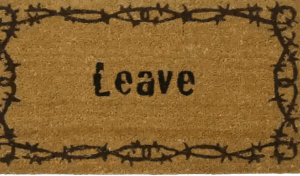
 Have you ever gone somewhere or worked someplace where you were made to feel unwelcome? It’s distressing and can really wear on a person. It’s no wonder that in real life, we try to avoid those situations when possible. When it’s not possible, we leave as soon as we can. In fiction, though, that lack of comfort can make for effective tension and even suspense. And in crime fiction, not being made welcome can be a motive for murder.
In Agatha Christie’s Taken at the Flood, we are introduced to Rosaleen Underhay Cloade. She had recently married wealthy Gordon Cloade and had come with him to England. Then, a wartime bomb killed him, leaving her a widow. Legally speaking, since Cloade died intestate, she is set to inherit his fortune, But Rosaleen hasn’t banked on Gordon’s siblings and their families. He had always assured them that they need not worry about money, as he would provide for them. But he never wrote that into a will, so now the other Cloades have been done out of their inheritances. When Rosaleen meets the Cloads, you can imagine the tension and how unwelcome she feels. She knows they were set to inherit, and they know she’s inheriting everything. Things change, though, when a stranger comes to town and says that Rosaleen’s first husband isn’t dead, as she had believed. If he is alive, then her marriage to Gordon Cloade is not legal, so she can’t inherit. When that stranger is found dead, it doesn’t take much to believe that it has something to do with the Cloade fortune. Hercule Poirot gets involved in the case when two members of the Cloade family ask him to investigate the stranger’s death.
In Shirley Jackson’s We Have Always Lived in the Castle, Mary Katherine ‘Merricat’ Blackwood tells the story of her family. She, her sister Constance, and their Uncle Julian live in an old home in a small New England town. The family is heartily disliked, for reasons that are soon clear. Six years earlier, three other members of the family were murdered, and the locals are convinced that Constance was responsible. So, the family is unwelcome in town, and nobody will speak to any Blackwoord unless absolutely necessary. Still, the family has managed to make a life. Then, a cousin, Charles Blackwood, comes for a visit. His presence touches off a series of events that lead to real tragedy. In this case, it’s not one person who’s made unwelcome; it’s a whole family.
Garry Disher’s Bitter Wash Road introduces Constable Paul ‘Hirsch’ Hirschhausen. He’s recently been transferred from Adelaide to the small town of Tiverton, in rural South Australia. Right from the beginning, he’s made to feel at the very least unwelcome. It’s been said he’s a whistleblower as a result of an internal investigation, and his police colleagues resent that, to put it mildly. When he arrives, they sabotage his work, refuse to be of any help, and worse. ‘Maggot’ is the nicest thing they call him. Then, the body of fifteen-year-old Melia Donovan is found by the side of Bitter Wash Road. None of Hirsch’s colleagues will work with him or give him any help, but he has a job to do. So he takes it on himself to follow up leads and try to find Melia’s killer. It’s a really strong example of how very unwelcome a person may be made to feel.
Liam McIlvanney’s The Quaker takes place in 1969 Glasgow, where an unknown killer dubbed the Quaker has murdered three young women. The only thing the victims had in common was that they went to the same dance club. But that fact doesn’t help much, and the police, hard-working as they are, have not made an arrest. Then, Detective Inspector Duncan McCormack is seconded to Glasgow to help in the search. Needless to say, his new colleagues do not want him there. They feel it’s a slap in the face, and McCormack is sent to lord it over them. McCormack is well aware of how they feel, and in that sense, he doesn’t blame them. Still, he has ideas to share and a different perspective. It takes a long time and a lot of work, but eventually he and the Glasgow team begin to work better together. In the end, they develop what you might call a grudging respect for each other. They find out who the Quaker is, too.
There’s also Emma Flint’s Little Deaths. In 1965 New York City, Ruth Malone is the single mother of Frankie Jr. and Cindy. People don’t think much of her; she works as a cocktail waitress, she drinks, she smokes, she dresses provocatively, and she has lovers. To matters worse, she’s divorced. At the time, that’s all considered contemptible, even sinful, and Ruth is not welcome in most places. Things get even worse for her when one morning, she wakes to find that Frankie Jr. and Cindy have gone missing. Thorough searches yield nothing at first. Then, tragically, the children are found dead. Now, the full brunt of local opinion and tabloid stories turn against Ruth. It’s assumed she must have killed the children. Even the police are happy to consider her guilty. But is she? Journalist Peter Wonicke decides to pursue the story and find out more about Ruth and about the night the children went missing. He finds that things may not be as simple as they seem.
It’s very hard to feel unwelcome, whether it’s a work, social, or other situation. But in fiction, that conflict can add suspense to a story. Which ones have stayed with you?
ps Thanks, Floormat Company, for the picture.
*NOTE: The title of this post is the title of a Tom Petty song.


This is such a great theme in crime fiction – I always feel sorry for the outsiders, even though sometimes the suspicions are entirely justified.
LikeLike
I think the theme is an excellent one for crime fiction, Marina Sofia. It works very well as source of background tension or a motive, among other things. I know what you mean about feeling sorry for the outsiders, too; I feel the same way. As you say, though, sometimes the wagging tongues are telling the truth…
LikeLike
It’s quite a recurring theme, the police officer who has gained a reputation by turning in one of their own and is hated as a result. I wonder if it happens as often in real life as in fiction!
LikeLike
You know, you ask a good question, FictionFan. I hadn’t really thought that way, but that’s a good point. I wonder in real life how often officers do that. I know it’s happened, but when it does, it makes the news. And that suggests it’s not common. But I can’t be sure.
LikeLiked by 1 person
Some great examples, and that outsider feeling can be so effective in crime fiction. Can I also say how I’m always impressed by the range of titles and authors you feature in your posts – you obviously have a wide knowledge of crime writing!
LikeLike
Thank you so much, KBR! That’s awfully kind of you. You’re right, too, about outsiders. That tension can add an awful lot to a story. And being an outsider certainly impacts character development, as I see it.
LikeLiked by 1 person
Great tension for fiction! We Have Always Lived in the Castle has always stuck with me, partly for that reason. 🙂
LikeLike
Isn’t that a great story, Elizabeth? I love the tension between the family and the villagers! 🙂
LikeLike
Margot, these are all great examples of this theme in crime fiction. And I have only read one of them, the Christie mystery of course. I have had Bitter Wash Road on my shelves for three years now, and you have motivated me to move it up on my To Read list.
LikeLike
Bitter Wash Road is an excellent book, I think, Tracy. It has a very strong sense of place (rural South Australia), and some well drawn characters. It’s a tough, gritty read in places, but well worth it. I hope you’ll enjoy it.
LikeLike
Such an interesting perspective, Margot! 📚 I love how you explore the power of setting boundaries and knowing when someone is no longer welcome. It’s fascinating how effectively that tension can drive a crime story and reveal so much about the characters. Excellent post, as always! ✨
LikeLike
Thank you very much, Mihran. I’m glad you enjoyed this post, and that you like what you find on this blog. You’re right, too, that the tension that comes from being unwelcome (or making someone feel unwelcome) can add to a crime story. And it’s something that resonates, because it happens in the real world.
LikeLike
Margot: Thanks for making me think. There are not as many outsiders as I thought in my crime fiction reading. I did think of Alison Gordon’s series featuring Kate Henry, the first female beat reporter to cover the Toronto major league baseball team. In real life Gordon was the first woman reporter to cover the Toronto Blue Jays. Both Henry and Gordon faced condescension, rudeness and disdain from some players. Others treated them with respect. Gordon won respect from the players over the years. I am sure she had some tough days and nights with how she was treated.
LikeLike
Thanks, Bill, for mentioning both Alison Gordon and Kate Henry. I hadn’t thought about that aspect of being an outsider when I was writing this post, so I’m glad you added that dimension. It’s quite true that being the first woman in a male-dominated job can make a person an outsider. And I’m quote sure both Henry and Gordon faced a lot of difficult times.
LikeLike