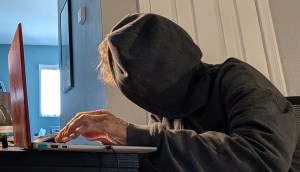
 With the advent of modern technology, we’ve now got a wide range of new ways to plan, commit, and catch crime. It used to be, for instance, that someone might steal a wallet or a credit card and use it in criminal way. That does still happen, of course, but online banking and shopping mean that criminals can also go after one’s identity or money online. And they do. Of course, this isn’t to say the police are unaware of this. Many police departments have whole units dedicated to catching cybercriminals. But it does mean that people need to be as alert when they pay bills online as they do when they pull their credit cards out at a brick-and-mortar store.
Crime fiction is keeping up with this form of crime. There are now a number of novels and series that focus on cybercrime, how it’s committed and how it’s stopped. It certainly opens up a number of possibilities for the crime writer.
For example, in Alafair Burke’s 212, we see how cyberstalking can work. Megan Gunther is a student at New York University (NYU). She belongs to an online group called Campus Juice, so she can keep informed on what’s happening at the university and, if she’s honest, to keep up with campus gossip. One day, to her shock, someone posts an eerie message:
Megan Gunther, someone is watching.
Also posted are her class schedule and social schedule (e.g. time when she goes to the gym). When Megan is found stabbed, NYPD detectives Ellie Hatcher and J.J. Rogan are assigned to the case and begin their investigation. The online aspects of the case give it a whole new and more complex dimension.
Sinéad Crowley’s Can Anybody Help Me? Is the story of Yvonne Mulhern. She and her husband Gerry have recently moved from London to Dublin, so Gerry can take advantage of a good job offer. With them, they bring their newborn daughter Róisín. Gerry works long hours, so it’s mostly Yvonne who has to tend to the never-ending needs of an infant. And she doesn’t really know anyone in Dublin, so she doesn’t have a circle of friends. Feeling lonely, exhausted and stressed, Yvonne joins an online group called Netmammy. The other members immediately welcome her and for once, Yvonne feels she has a support network. Then, one of the other members of the group goes silent. Yvonne is concerned enough to go to the police, but there’s not much they can do. Then, the body of a woman is discovered in an empty apartment. Garda Sergeant Claire Boyle investigates, and when she finds out Yvonne was already in contact with the police, she follows up. If the body is that of the missing member of Netmammy, then no-one in the group is really safe.
Cat Connor’s Killerbyte is the first of her stories featuring FBI agent Ellie Conway Iverson. In it, Ellie and her partner Mac Connelly are co-moderators of an online poetry group called Cobwebs. When Ellie has to ban Connor McClaren from the group, he goes to her home and harasses her. He’s arrested, but he manages to make bail. Then, he’s found murdered. Next to the body is an adhesive note with a poem on it. Then there’s another murder. It’s soon clear that someone is stalking the members of Cobwebs. Now, Ellie and Mac have to race against time if they’re not to be the next victims. Connor’s other series, the Veronica Tracey, PI series, features cutting-edge technology including drones, data theft, online surveillance, and more.
Qiu Xiaolong’s The Enigma of China raises some interesting questions about online activity and what may or may not be considered a crime. In the novel, Shanghai police detective Chen Cao investigates when the body of Zhou Keng, Head of Shanghai’s Housing Development Committee, is found in a hotel room. The official explanation is that he committed suicide after being arrested for corruption and confined to the hotel to await his trial. But Chen isn’t sure it’s a case of suicide. As he investigates, he meets the members of an online group that works to expose and stop corruption at the upper echelons of Chinese government. On the one hand, criticism of the government is a dangerous thing to do, and certain online activity is illegal and harshly punished. So in that sense, the group’s work is against the law. On the other hand, it was that group that unearthed the evidence that got Zhou arrested, and the government needs to show that it does not tolerate corruption, It’s an interesting look at what ‘counts’ as dangerous online activity.
There’s also Ian Hamilton’s Ava Lee series. Ava is a forensic accountant, and she’s very, very good at what she does. In several books in the series, she works for a shadowy Hong Kong-based company owned by Chow Tung, whom Ava calls ‘Uncle.’ The company’s specialty is recovering stolen money, and most of the clients are desperate people who, for whatever reason, cannot go to the police to get their money back. The criminals use a variety of methods, including electronic bank fraud and more, to steal the money. They also use an effective variety of ways to hide that money in places like hidden offshore accounts and ‘dummy’ corporations. Ava is thoroughly familiar with the way criminals use technology to steal and hide money. And she has her own strategies to track down that missing money and get it back.
There are a lot of other books and series, too, that feature Internet and other modern technology as weapons and as tools for detection. That technology is a part of our lives now, and that includes the world of crime, crime prevention, and crime detection. Which books and series have stayed with you?
*NOTE: The title of this post is a line from Kate Bush’s Deeper Understanding.
 Crime Writer Margot Kinberg
Can Anybody Help Me? Sounds quite good Margot.
LikeLiked by 1 person
I thought it was very well done, June. Several layers to it, and things not as they seem. If you try it, I hope you’ll enuoy it.
LikeLike
Thank you for getting killerbyte (FBI-Byte Series) and the Veronica Tracey Spy/PI series in there! I sometimes forget how much tech I actually use. Guess it’s a sign of the times. 🙂
LikeLiked by 1 person
Oh, and you use tech so well, too, Cat! Both your series have some fascinating exploration of where we’re going technologically speaking, and what it all means. 🙂
LikeLiked by 1 person
You are very kind! 🙂
LikeLike
And truthful… 😀
LikeLike
The Enigma of China sounds good. I read one of his books years ago and fully intended to read more, but you know how that goes! However I do have another on my TBR, so it’ll happen eventually…
LikeLiked by 1 person
I thought The Enigma of China was very good, FictionFan. I like the rest of the series, too, but yes, I know exactly how it is! There are just soooo many books that I will get to – I really will – promise! At some point… When you get to more of Qiu’s work, I hope you’ll enjoy it.
LikeLiked by 1 person
Margot: You have written an important post. We are entering an age where it is easy to think of computers as “people” rather than “machines”. The Proving Ground by Michael Connelly explored a civil trial being conducted by Mickey Haller where a chatbot convinced a teenage boy to get rid of his girlfriend because the chatbot avatar Wren, unlike his girlfriend, would always be there for him. Unfortunately, it is not theoretical. American Congress heard from a father about how a chatbot encouraged a teenage boy to consider and then commit suicide. I subsequently gave a reflection at church on how chatbots are the great tempter to do evil of this generation.
LikeLiked by 1 person
Thanks, Bill, for your insights. My post didn’t explore chatbots, so I’m very glad you added that to it. Chatbots and other technology really can make people think of computers as people, which they are not, of course. And that can lead to all sorts of disaster. Thanks also for mentioning The Proving Ground. It is a very effective example of how people’s thinking about computers can be impacted, and it raises all sorts of important and disturbing questions. Folks, do read Bill’s excellent review of The Proving Ground. And you’re right; the questions and challenges in the novel are not theoretical. We’re wrestling with them right now.
LikeLiked by 1 person
Technology has really changed crime in so many ways, hasn’t it? All the cybercrime, and now of course the possibilities AI presents (and not in a good way). Although perhaps it’s made things a little harder in that there are so many records and digital footprints that it could be more difficult for criminals to completely disappear nowadays!
LikeLike
You’re quite right about technology. It has changed crime and its detection in fundamental ways. And I’m glad you mentioned AI. That’s a whole new reality that’s going to require a whole new way of thinking. It’s interesting, too, to think about the way technology has make police work easier. It really is harder for a criminal to get away with things, what with CCTV, digital footprints, and so on. And perhaps that even cuts down on some crime!
LikeLiked by 1 person